The AI Discovery Funnel: How Customers Find Brands In The AI Era
AI Brand Report ·
The traditional marketing funnel is being reshaped by AI. Discovery now begins inside AI assistants - and the brands that appear in those early responses dominate the consideration stage before users ever reach a website.
For more than two decades, marketers refined their approach to the digital marketing funnel - moving prospects from awareness through consideration to conversion, with search engines powering much of the discovery process.
That model is being fundamentally reshaped.
AI assistants, generative search engines, and conversational interfaces are increasingly mediating brand discovery - intervening between user intent and brand websites in ways that compress, redirect, and transform the traditional journey. Users who once ran multiple search queries across several sessions are now consulting a single AI assistant for a synthesized recommendation.
Understanding the AI discovery funnel is now essential for any brand that wants to remain visible to prospects at the moments that matter most.
What Is The AI Discovery Funnel?
The AI discovery funnel describes the customer journey in an environment where AI assistants - rather than search engines and browsing - mediate the initial stages of brand discovery and evaluation.
In the traditional digital funnel, users moved through awareness, consideration, and decision stages by actively engaging with multiple websites, search results, and content sources. Each stage involved significant independent research across many touchpoints.
In the AI discovery funnel, an AI assistant collapses awareness and consideration into a single synthesized response. The user asks a question; the AI presents a curated shortlist with context already applied. The journey from "I have a need" to "here are the brands I should consider" now happens within seconds - inside a conversation, rather than across dozens of website visits.
This compression has profound implications for how brands approach marketing strategy. AI Brand Visibility - your presence in those AI-generated recommendations - has become one of the most important metrics in modern marketing.
Why The AI Discovery Funnel Matters
Awareness And Consideration Now Collapse Into One Moment
In the traditional funnel, a brand could capture awareness at one touchpoint and consideration at another - with multiple opportunities to enter the journey. In the AI discovery funnel, these stages collapse into a single AI response. If your brand doesn't appear in that response, it may be skipped entirely - regardless of how strong your downstream website experience or conversion optimization might be.
Brands Are Evaluated Before The First Website Visit
Because AI assistants present pre-evaluated shortlists, users arrive at brand websites with their consideration set already formed. Brands compete for inclusion in the AI summary - not just for rankings or clicks. If you're not in the summary, you may not be in the consideration set at all.
Click Behavior Is Changing Across Industries
Research across many sectors is showing declining organic click-through rates as AI summaries answer queries without requiring navigation. Users receive the synthesis they need and visit only one or two sources - typically to validate a decision already partially made. This makes appearance in AI summaries more valuable than any single click.
Zero-Visit Brand Discovery Is Becoming Normal
In many cases, users form opinions about brands - including purchase intent - entirely through AI summaries, without ever visiting the brand's website. Brands that are consistently recommended in AI responses build recognition and consideration even among users who never click through. This is the new reality of digital brand awareness.
How The AI Discovery Funnel Works
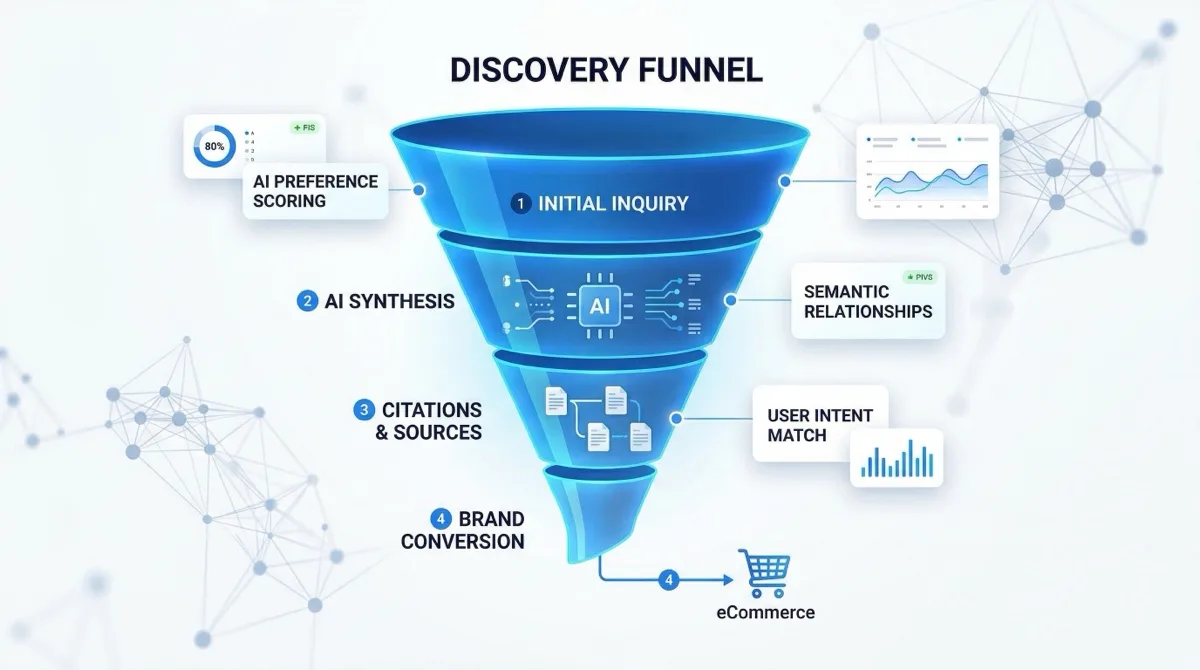
The AI discovery funnel unfolds across five stages:
Stage One: Intent Formation - A user recognizes a need or problem. This stage is unchanged from the traditional model. What follows is dramatically different.
Stage Two: AI Consultation - Instead of typing short keywords into a search engine, the user turns to an AI assistant with a conversational query. Rather than "project management software," they ask: "What project management platforms work best for a remote creative agency with 15 people?" The AI interprets intent, not just keywords.
Stage Three: Shortlist Formation - The AI response creates the user's consideration set. The brands that appear in that response - typically three to five options with brief descriptions - are the brands that enter the purchase journey. This is where AI recommendation engines do their most significant work: shaping which brands users know to consider at all.
Stage Four: Selective Website Visits - After receiving an AI recommendation, users typically visit one or two of the suggested brands - not to research broadly, but to validate a decision they're already leaning toward. These are intent-rich visits with significantly higher purchase readiness than the exploratory visits that characterized the traditional funnel.
Stage Five: Conversion - With the consideration set narrowed by AI, conversion often occurs with less comparison-shopping than the traditional model. The AI has already compressed the evaluation process.
Practical Strategies For The AI Discovery Funnel
Optimize for the AI response, not just the click. Invest in the signals that drive AI recommendation inclusion - third-party authority, narrative consistency, category association - rather than focusing exclusively on click-through optimization. The battle is increasingly won before the click.
Establish clear category authority. AI systems must clearly understand which category your brand belongs to before they can include it in category-level recommendations. Ensure that your website, content, and external mentions all explicitly and consistently signal your category and primary use cases. Read more about this in our guide to brand narrative engineering.
Build third-party presence systematically. AI systems often weight independent sources more heavily than self-published content. Coverage in respected industry publications, positive reviews on trusted platforms, and inclusion in authoritative directories all strengthen your AI discovery funnel position. This is precisely why PR has become the new SEO in the AI era.
Appear in comparison contexts. AI users frequently ask comparative questions - "best alternatives to X" or "top tools for Y." Brands that appear prominently in comparison content, "best of" lists, and competitive overviews build stronger AI discovery presence than brands that appear only on their own properties.
Monitor your appearance rate. Because the AI discovery funnel begins inside AI responses, tracking how frequently your brand appears in relevant AI queries is a fundamental marketing metric. Without this data, you cannot know whether your funnel is functioning or where the gaps are. See our guide on AI brand monitoring to get started.
Understand AI search vs. traditional search. The dynamics of AI discovery differ significantly from traditional search - and your strategy should reflect both environments rather than treating them as equivalent.
Examples
The Software Vendor With A Pipeline Gap: A project management platform company finds that despite strong Google rankings and a well-optimized website, their inbound pipeline is weakening. Investigation reveals that a growing share of their target audience now starts research with an AI assistant - and the company rarely appears in AI recommendations. By investing in industry publication coverage, improving their brand narrative consistency, and building directory presence, they begin appearing in AI shortlists and recover pipeline health within two quarters.
The Travel Brand That Discovered Zero-Visit Awareness: A boutique hotel group notices that direct booking inquiries increasingly reference "my AI assistant recommended you." They investigate and find that consistent positive reviews, accurate travel directory listings, and strong press coverage have resulted in regular AI recommendation appearances for queries like "boutique hotels in [city] with good restaurant access." They lean into these signals, and AI-referred direct bookings become a growing share of their revenue.
Key Takeaways
- The AI discovery funnel collapses awareness and consideration into a single AI response
- Brands not included in AI responses may never enter the user's consideration set at all
- Website visits are becoming selective and intent-rich rather than exploratory
- The core strategies are: AI-driven signal building, category clarity, third-party authority, and comparison context
- Zero-visit brand discovery is real - AI recommendations build recognition and consideration without requiring clicks
- Monitoring your AI appearance rate is now a fundamental marketing metric alongside rankings and traffic
Frequently Asked Questions
What should you check first?
Start by testing the prompts your buyers are most likely to ask. Look for whether your brand appears, how it is described, which competitors appear beside it, and whether the answer points to credible sources.
How often should teams review this?
Monthly is the minimum useful cadence for most teams. Weekly reviews make sense during launches, competitive campaigns, PR activity, or any period where AI-generated answers could shift quickly.
How can AI Brand Report help?
AI Brand Report runs structured prompt checks across major AI engines, tracks brand and competitor visibility, and turns the results into a prioritized list of actions so your team can improve how AI systems describe and recommend your brand.
Check Your AI Visibility
If you want to see how AI systems describe and recommend your brand today, start with a free AI visibility report. AI Brand Report checks your presence across major AI engines, compares your visibility against competitors, and highlights the gaps most worth fixing first.
Get your free AI visibility report.
Related Articles
-
AI Brand Visibility: The Complete Guide To Being Recommended By AI Systems - The comprehensive framework for managing your AI brand presence
-
AI Search Vs Traditional Search: What Changes For Brands - How AI search differs fundamentally from traditional search
-
The Rise Of AI Recommendation Engines - How AI systems function as recommendation engines across every industry
-
Why PR Is The New SEO In The Age Of AI - Why earned media drives AI visibility more than owned content
-
AI Brand Monitoring - How to systematically track your brand's visibility across AI systems
-
The Future Of Brand Discovery In The Age Of AI - Where AI-mediated discovery is heading and how to prepare now