AI Search Vs Traditional Search: What Changes For Brands
AI Brand Report ·
AI search doesn't present links - it synthesizes answers. This fundamental difference transforms how brands must approach digital visibility and changes which companies win discovery in their categories.
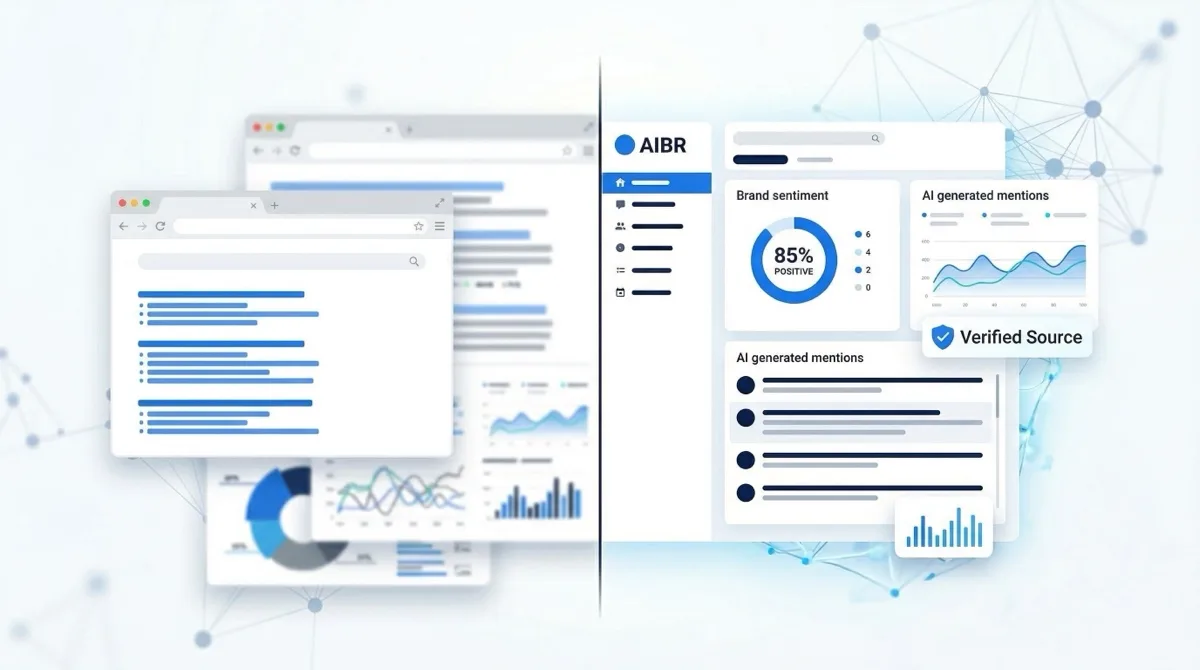
For more than two decades, traditional search engines defined the rules of digital discovery. Brands optimized pages, built backlinks, and competed for rankings - with the goal of appearing as high as possible in a list of results. The playbook was well understood and well resourced.
AI search changes the fundamental nature of that competition.
Instead of presenting a list of links for users to evaluate independently, AI search synthesizes an answer. It reads, aggregates, and interprets information from across the web - presenting users with a direct recommendation or summary rather than a menu of options to explore. This difference is not merely technical. It represents a transformation in how brands are discovered, evaluated, and recommended - with major implications for every marketing team.
What Is AI Search?
AI search is a category of search experience in which an AI system interprets a user's query, retrieves and aggregates relevant information from multiple sources, and synthesizes a direct response - rather than returning a ranked list of links.
AI search systems include standalone AI assistants (such as ChatGPT, Perplexity, and Claude) and AI-augmented features within traditional search engines (such as Google's AI Overviews and Bing's Copilot integration). What they share is the characteristic output: a synthesized response that directly addresses the user's question, often without requiring any click to external sources.
This contrasts with traditional search, where the user submits a query and receives an ordered list of results - typically ten links per page, ranked by relevance and authority - that the user evaluates independently.
The AI discovery funnel that results from AI search is structurally different from the journey that traditional search enables, and understanding the distinction is essential for brands building modern discovery strategies.
Why The Difference Matters
The Website Is No Longer The First Point Of Contact
In traditional search, the website is where discovery happens. Users click through from search results and encounter the brand directly. The website's content, design, and messaging shape first impressions.
In AI search, the AI summary often shapes first impressions before any website is visited. By the time a user reaches your website - if they do at all - they've already received an AI-curated description of your brand. The website becomes a validation experience rather than a discovery one.
Visibility Rules Have Changed
In traditional search, visibility is determined primarily by technical SEO, backlink profiles, and on-page optimization. In AI search, visibility is determined by the strength and consistency of your brand's signal landscape across the entire web - including third-party coverage, reviews, comparative context, and structured data.
These are different disciplines requiring different investments. Brands that recognize this shift will adapt their strategies accordingly rather than assuming that what works in traditional search also works in AI search.
Click Behavior Is Shifting
Traditional search generates significant click activity. AI search increasingly resolves queries without clicks - users receive the synthesis they need without visiting source websites. Organic click-through rates have declined in many industries where AI summaries are prevalent, and the trend is accelerating as AI search capabilities mature.
How Traditional Search Works
In traditional search, the user submits a query and receives a ranked results page. The brand's objectives are straightforward: appear high in results, attract clicks through compelling titles and descriptions, and convert visitors through website experience and content.
The traditional search equation: Good rankings → clicks → website visits → consideration → conversion
This model rewards technical SEO excellence, content volume, backlink acquisition, and conversion rate optimization. The website is the primary competitive asset, and traffic is the primary metric.
How AI Search Works
AI search restructures this equation entirely. When a user queries an AI system, the system:
- Interprets the user's intent (not just their keywords)
- Retrieves and aggregates information from multiple sources
- Synthesizes a direct answer, recommendation, or comparison
- Presents that synthesis - often without requiring any click
Instead of ten links, the user receives something like:
"The most recommended platforms for small agency project management include X, Y, and Z. X is particularly strong for creative workflows, while Z offers the best integration options for teams already using [tool]..."
The AI has done the evaluation. The user receives a curated summary that already embeds a recommendation and comparative framing.
The AI search equation: Strong brand signals across the web → AI inclusion → summary appearance → recognition and consideration → selective website validation → conversion
This model rewards brand narrative consistency, third-party authority signals, category clarity, and comparative context - not just on-page optimization.
Key Differences At A Glance
| Dimension | Traditional Search | AI Search |
|---|---|---|
| Output format | Ranked list of links | Synthesized answer with embedded recommendations |
| What drives visibility | Technical SEO, backlinks, page optimization | Narrative consistency, third-party authority, category signals |
| Role of the website | Primary discovery and conversion asset | Supporting signal and validation destination |
| User journey | Browse multiple sites, independent evaluation | Receive synthesis, selective validation visits |
| Number of visible brands | Up to 10+ per page | Typically 3–5 in a summary |
| Click behavior | Significant click activity expected | Increasingly click-free resolution |
| Query style | Short keyword-based queries | Longer, conversational, intent-rich questions |
| Primary metric | Rankings, traffic, CTR | AI appearance rate, narrative accuracy |
Practical Strategies For Both Environments
Continue investing in traditional SEO. Traditional search is not going away, and strong website content, technical SEO, and backlink profiles all contribute to AI understanding of your brand. Generative Engine Optimization and the broader practice of AI search optimization build on SEO rather than replacing it - treat them as complementary disciplines.
Build brand narrative signals across the web. AI search visibility requires a consistent, credible brand presence across multiple independent sources. Invest in earned media, directory listings, and expert mentions - not just website optimization. Every authoritative third-party mention strengthens your AI signal landscape.
Pursue third-party authority strategically. AI systems weight independent sources heavily. Coverage in respected industry publications, positive reviews on trusted platforms, and inclusion in authoritative comparison sites all drive AI recommendation frequency. This is why PR has become the new SEO - earned media is now a direct driver of brand discoverability.
Ensure category clarity across all channels. AI systems must be confident about which category your brand belongs to before they can recommend it. Make your category explicit and consistent across your website, PR materials, directory listings, and partner content.
Use structured data to provide machine-readable context. Schema markup gives AI systems direct, accurate information about your organization, products, and services - reducing interpretation errors that can suppress AI recommendations.
Monitor AI visibility separately from traditional search metrics. Rankings and traffic data tell you how you're performing in traditional search. AI appearance rate and narrative accuracy tell you how you're performing in AI search. Both sets of metrics matter, and neither can substitute for the other. Build an AI brand monitoring practice alongside your traditional analytics.
Examples
The Invisible SEO Leader: A cybersecurity software company ranks #2 in traditional search for their primary keywords and has significant organic traffic. But when prospects ask AI assistants for cybersecurity platform recommendations, the company rarely appears. Investigation reveals that despite strong technical SEO, they have limited third-party coverage and inconsistent descriptions across external sources. Their SEO success has not translated into AI visibility - because the signals that drive AI recommendations are different from those that drive search rankings.
The AI-First Challenger: A newer entrant in the same category has weaker traditional search rankings but has invested heavily in industry PR, software review platform presence, and comparison content. They appear consistently in AI recommendations despite being less visible in traditional search. They are capturing discovery from prospects who start with AI assistants - which increasingly means the prospects most likely to purchase quickly.
Key Takeaways
- AI search synthesizes answers rather than presenting links - a structural difference with major strategic implications
- Traditional search and AI search reward different signals: SEO optimization vs. brand narrative and third-party authority
- The website shifts from a discovery asset to a validation destination in AI search environments
- AI search presents fewer options (3–5 brands) than traditional search, making shortlist inclusion critical
- Organic click-through rates are declining in categories with strong AI summary coverage
- Effective strategy requires investment in both traditional SEO and AI-specific brand signal building
- Monitoring AI visibility requires different tools and metrics than traditional search analytics
Frequently Asked Questions
What should you check first?
Start by testing the prompts your buyers are most likely to ask. Look for whether your brand appears, how it is described, which competitors appear beside it, and whether the answer points to credible sources.
How often should teams review this?
Monthly is the minimum useful cadence for most teams. Weekly reviews make sense during launches, competitive campaigns, PR activity, or any period where AI-generated answers could shift quickly.
How can AI Brand Report help?
AI Brand Report runs structured prompt checks across major AI engines, tracks brand and competitor visibility, and turns the results into a prioritized list of actions so your team can improve how AI systems describe and recommend your brand.
Check Your AI Visibility
If you want to see how AI systems describe and recommend your brand today, start with a free AI visibility report. AI Brand Report checks your presence across major AI engines, compares your visibility against competitors, and highlights the gaps most worth fixing first.
Get your free AI visibility report.
Related Articles
-
AI Brand Visibility: The Complete Guide To Being Recommended By AI Systems - The comprehensive framework for managing your brand's AI presence
-
Generative Engine Optimization (GEO) - The discipline for optimizing brand presence specifically for AI-generated answers
-
The Rise Of AI Recommendation Engines - How AI systems function as recommendation engines across industries
-
Why PR Is The New SEO In The Age Of AI - Why earned media drives AI visibility more than owned content
-
Structured Data For AI Visibility - How machine-readable markup improves AI brand understanding
-
The AI Discovery Funnel - How AI reshapes the full customer journey from first intent to conversion