Why AI Brand Monitoring Is Now Essential
AI Brand Report ·
AI-generated narratives evolve constantly. Learn why tracking how AI systems describe your brand is becoming a critical marketing capability - and how to build a monitoring strategy that keeps you ahead.
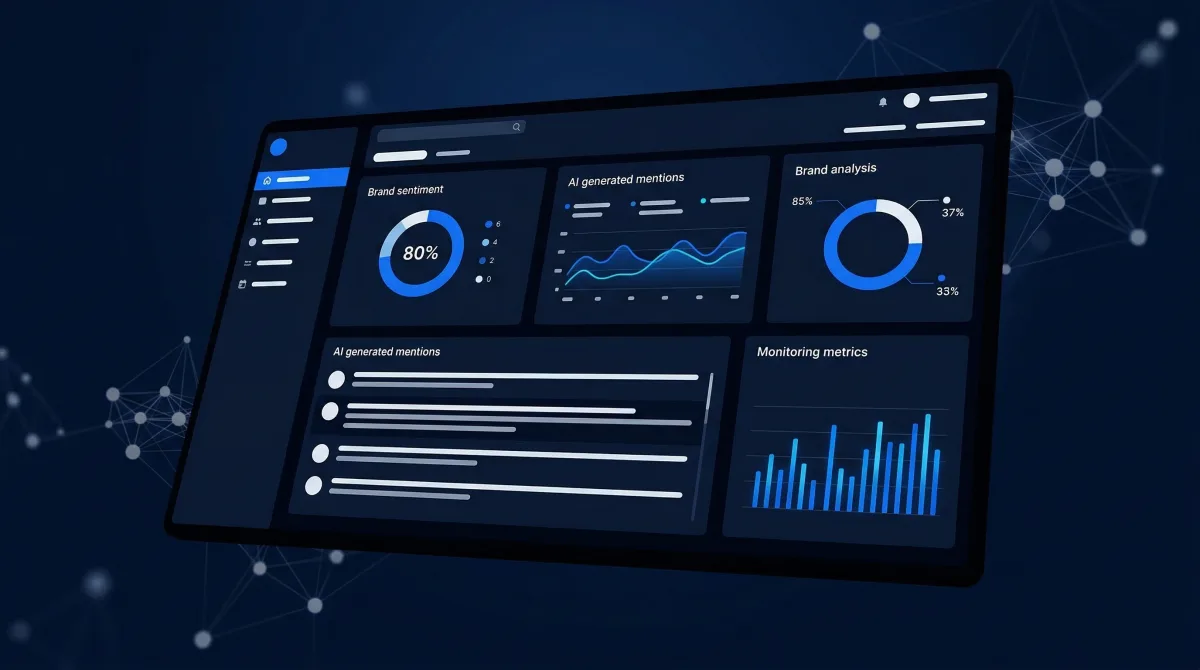
The internet does not stand still - and neither do AI systems. That is why AI brand monitoring is increasingly tied to AI visibility tracking: teams need to know not only what AI says about their brand, but whether the brand appears for the buyer questions that shape demand.
Every day, new content is published, competitors earn media coverage, reviews are updated, and the signals that AI assistants use to describe your brand shift accordingly. Unlike a website that you can audit once and optimize, your brand's presence in AI-generated responses is dynamic. It evolves continuously based on what is being published, indexed, and synthesized across the web.
This is why AI brand monitoring has become an essential marketing discipline. Without it, brands can lose recommendation visibility without any warning. Narratives can drift in ways that misrepresent positioning. Competitors can displace you in AI summaries while you remain unaware. And by the time the problem is visible, opportunities have already been lost.
AI Brand Monitoring vs. AI Visibility Tracking
AI brand monitoring tracks how AI systems describe, cite, and frame your brand over time. AI visibility tracking adds another layer: whether your brand appears at all for the category, comparison, and problem-solving prompts your buyers use.
Both matter. A brand can have accurate descriptions on branded prompts and still be invisible for high-intent category searches. A useful monitoring workflow should therefore track brand mentions, sentiment, competitors, citations, and prompt-level visibility together.
If you need a deeper measurement framework, read our guide to AI visibility trackers and our comparison of the best AI visibility tools.
What Is AI Brand Monitoring?
AI brand monitoring is the practice of systematically tracking how AI assistants, generative search engines, and conversational interfaces describe and recommend your brand across relevant queries.
Traditional brand monitoring focuses on social media mentions, press clippings, and review platforms. AI brand monitoring focuses specifically on the synthesized outputs that AI systems produce - the recommendations, summaries, and comparisons that users receive when they ask AI assistants questions relevant to your category.
When a user asks "What are the best platforms for managing client projects?", AI brand monitoring asks: does your brand appear in that response? If so, how is it described, what context surrounds it, and how does that framing compare to competitors who appear in the same answer?
The goal is to understand and proactively manage the narrative that AI systems construct around your brand - ensuring it is accurate, compelling, and competitive within your category.
Why AI Brand Monitoring Matters
AI Recommendations Influence Decisions Before Website Visits
Users increasingly trust AI-generated summaries over conducting their own independent research. When an AI assistant presents a shortlist of recommended solutions, that recommendation shapes the user's consideration set - often before a single website is visited.
If your brand is absent from the shortlist, you may be losing prospects at the very first stage of their discovery journey - invisibly, at scale, and repeatedly.
AI Narratives Change Constantly
AI systems update their understanding of brands continuously as new content is indexed, new signals emerge, and models are refreshed. A competitor's major product launch, a surge of negative reviews, or a significant media story can shift how AI systems describe your brand within days.
Without monitoring, these shifts go undetected until they've already influenced significant numbers of prospects.
Competitors Can Displace Your Brand Silently
When competitors strengthen their content, earn media coverage, or accumulate stronger third-party signals, they can rise in AI recommendation frequency - often at the expense of brands with weaker signal landscapes. Monitoring provides early warning when competitive threats begin eroding your position, allowing you to respond before the damage compounds.
Inaccuracies Persist Without Intervention
AI systems sometimes describe brands inaccurately - listing outdated product features, incorrect pricing tiers, or mischaracterized target markets. Without monitoring, these inaccuracies can influence potential customers for months before anyone notices. The longer they persist, the more prospects are shaped by a narrative your team never intended.
How AI Brand Monitoring Works
Effective AI brand monitoring is a structured, repeatable process with four core components:
Defining your query universe - Identify the queries where your brand needs to appear. These typically include category queries ("Best [category] platforms"), problem-solution queries ("How do I solve [problem]?"), comparison queries ("[Competitor] alternatives"), and use-case queries ("[Category] for [specific industry]"). This set becomes the prompts you test regularly to track your visibility.
Establishing a baseline - Before tracking change, understand your starting position. An initial audit across your query universe reveals how frequently your brand appears, how it is described, which competitors appear alongside you, and where significant gaps exist.
Running regular audits - Because AI narratives shift continuously, monitoring should occur on a defined cadence - at minimum monthly, more frequently in competitive categories. Each audit compares results against the baseline and previous periods to identify meaningful trends.
Tracking key metrics - A comprehensive monitoring program tracks: appearance rate (how frequently your brand appears), narrative accuracy (whether descriptions match your positioning), sentiment (whether framing is positive or negative), competitive share (which competitors appear more or less than you), and trend trajectory (whether visibility is improving or declining over time).
Practical Strategies For AI Brand Monitoring
Connect monitoring to action. Data without response is just observation. When monitoring reveals gaps, inaccuracies, or competitive threats, use that intelligence to prioritize content creation, PR outreach, website updates, or structured data improvements. Build a response protocol so that every significant finding triggers a defined action.
Benchmark against competitors. Your visibility does not exist in isolation. Tracking competitors across the same query universe reveals where they are gaining ground, what narratives they're being credited for, and where opportunities exist for your brand to step into.
Test across multiple AI platforms. Different AI assistants (ChatGPT, Gemini, Claude, Grok, Perplexity) draw on different signals and may produce meaningfully different brand descriptions. Testing across platforms gives a more complete picture of your AI narrative landscape. For ChatGPT specifically, our guide on how to track your brand in ChatGPT covers the manual and automated approaches teams use to build that baseline.
Align monitoring insights with your brand narrative engineering strategy. The gaps monitoring reveals should directly inform the narrative you're working to strengthen across owned, earned, and structured content.
Document changes over time. When monitoring reveals a significant shift, document it with timestamps and note potential causes. This historical record helps you identify patterns, attribute changes to specific events, and build institutional knowledge about what drives your AI visibility.
Examples
The Disappearing Brand: A B2B software company with strong traditional SEO discovers through AI monitoring that it rarely appears in AI responses to category queries - despite ranking well in Google. Investigation reveals that while their website is well-optimized, they have minimal third-party coverage and no presence in industry directories that AI systems draw on. This insight redirects their marketing investment toward earned media and authority-building. Six months later, monitoring shows significantly improved AI recommendation frequency.
The Narrative Drift: A marketing agency monitors AI responses to queries about their specialty. They discover that AI systems are consistently describing them as a "general marketing agency" rather than their actual positioning as a B2B technology marketing specialist. By publishing targeted thought leadership, pursuing relevant PR placements, and updating directory listings to reflect their niche, they correct the narrative. Subsequent monitoring confirms that AI descriptions increasingly reflect their intended positioning.
Key Takeaways
- AI brand monitoring tracks how AI assistants describe and recommend your brand across relevant queries
- AI narratives change constantly - competitors, new content, and model updates all shift AI outputs
- The core metrics to track are: appearance rate, narrative accuracy, sentiment, competitive share, and trend trajectory
- Effective monitoring requires a defined query universe, regular cadence, and direct connection to strategic action
- Monitoring is most powerful when integrated with brand narrative engineering and a GEO strategy
Frequently Asked Questions
What should you check first?
Start by testing the prompts your buyers are most likely to ask. Look for whether your brand appears, how it is described, which competitors appear beside it, and whether the answer points to credible sources.
How often should teams review this?
Monthly is the minimum useful cadence for most teams. Weekly reviews make sense during launches, competitive campaigns, PR activity, or any period where AI-generated answers could shift quickly.
How can AI Brand Report help?
AI Brand Report runs structured prompt checks across major AI engines, tracks brand and competitor visibility, and turns the results into a prioritized list of actions so your team can improve how AI systems describe and recommend your brand.
Practical Example
A marketing team can start with a focused baseline: choose 10 to 20 buyer prompts, run them across the major AI engines, and record whether the brand appears, how it is described, and which competitors are recommended instead.
From there, the team can prioritize the highest-impact gaps: unclear positioning, missing comparison content, weak third-party mentions, outdated review signals, or pages that do not answer buyer questions directly enough for AI systems to cite.
Check Your AI Visibility
If you want to see how AI systems describe and recommend your brand today, start with a free AI visibility report. AI Brand Report checks your presence across major AI engines, compares your visibility against competitors, and highlights the gaps most worth fixing first.
Get your free AI visibility report.
AI Brand Monitoring Tool vs. AI Mention Tracker
A basic AI mention tracker can tell you whether your brand appeared in an AI answer. That is a useful starting point, but it is not enough to manage brand visibility in AI search.
AI brand monitoring should also answer the questions behind the mention: Was the description accurate? Was the sentiment positive, neutral, or negative? Which competitors appeared in the same answer? Which sources shaped the response? Did your visibility improve or decline compared with the last audit?
That broader context is what turns monitoring into a strategy. Without it, teams collect screenshots and anecdotes. With it, they can prioritize content updates, PR opportunities, review campaigns, structured data improvements, and competitive positioning work based on actual AI visibility gaps.
Related Articles
-
AI Brand Visibility: The Complete Guide To Being Recommended By AI Systems - The comprehensive framework for understanding and managing your AI presence
-
Brand Narrative Engineering For AI Systems - How to actively shape the signals AI systems use to describe your brand
-
How AI Assistants Choose Which Brands To Recommend - The specific signals AI systems evaluate when deciding which brands to include
-
Generative Engine Optimization (GEO) - The discipline of optimizing brand presence for AI-generated answers
-
The Future Of Brand Discovery In The Age Of AI - Where AI-mediated brand discovery is heading and how to prepare