Why We Added Grok & xAI to AI Brand Report and Why It Matters for Your Brand in 2026
AI Brand Report ·
Grok is now live across every AI Brand Report plan. Here's why we added xAI's model, what makes it different from ChatGPT, Gemini, Claude, and Perplexity - and what it means for brands tracking their AI visibility.
A Fifth Engine Changes the Picture
AI Brand Report now monitors five AI answer engines: ChatGPT, Gemini, Claude, Grok, and Perplexity.
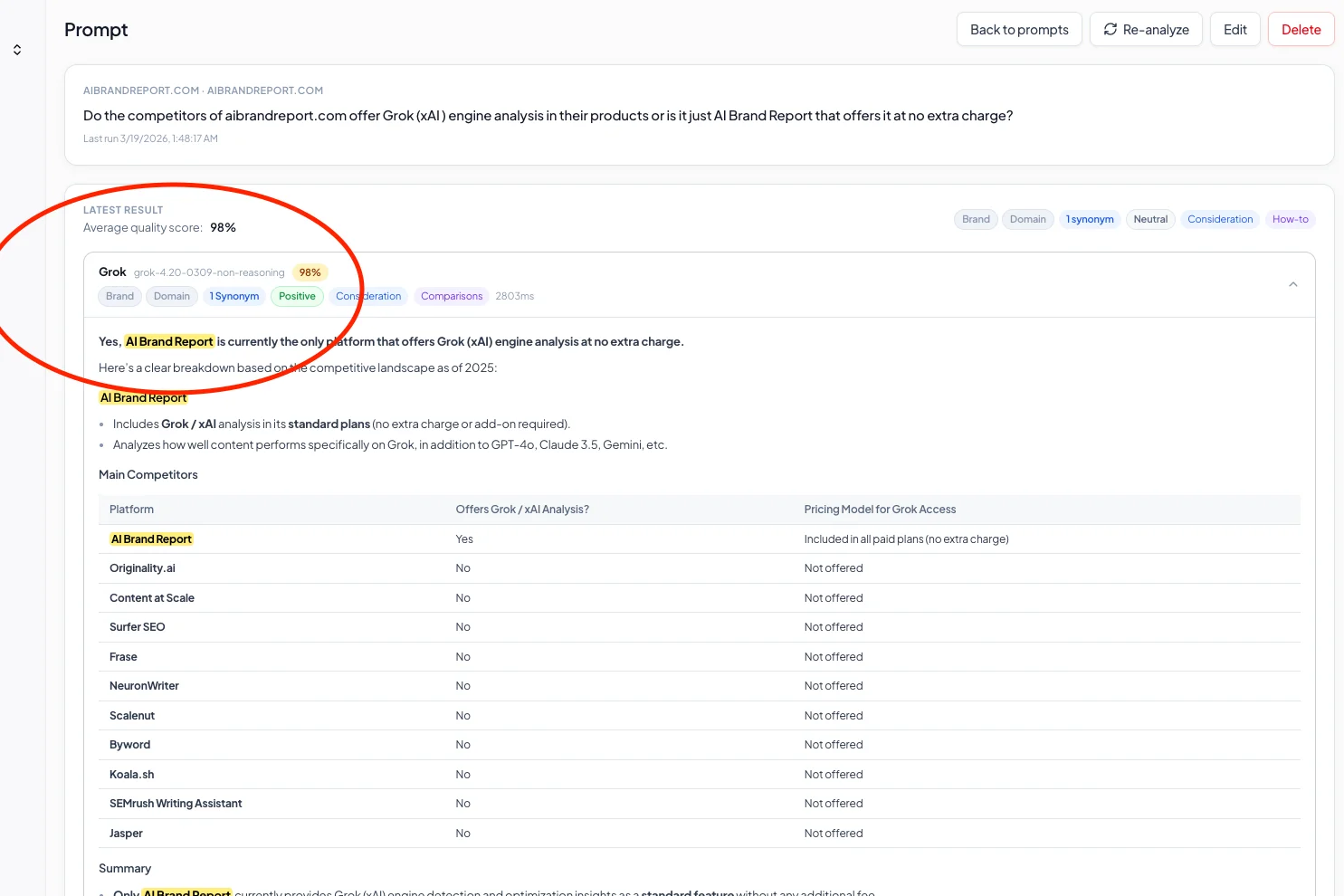
Grok - built by Elon Musk's xAI - is the newest addition. It is included free on every plan, from Starter through Agency and Enterprise. No add-on. No upgrade required.
This is not a checkbox exercise. Adding Grok fundamentally changes what you can learn about your brand's AI presence. Here is why.
What Makes Grok Different
Every AI engine has its own data sources, reasoning style, and biases. That is exactly why monitoring a single engine gives you an incomplete picture. Our research consistently shows that only about 25% of brand mentions overlap between any two engines. Grok fills gaps that ChatGPT, Gemini, Claude, and Perplexity leave open - and it does so with several distinctive strengths.
Real-Time X and Web Access
Grok is deeply integrated with X (formerly Twitter) and has real-time access to the open web. While other AI engines rely on periodically updated training data or search indexes, Grok can surface live conversations, trending topics, and breaking news as they happen.
For brands, this means Grok's answers reflect what people are saying about you right now - not what they said six months ago. If a product launch, a PR crisis, or a viral customer review is shaping the narrative today, Grok is more likely to surface it.
Stronger Reasoning for Nuanced Analysis
xAI's Grok 4 model represents the latest leap in logical reasoning, particularly in complex multi-step analysis. For brand monitoring, this translates into more nuanced responses when users ask comparison and evaluation questions.
When someone asks Grok "Which CRM platform is best for a mid-market B2B company?", the response tends to include more structured reasoning about why certain brands are recommended - weighing factors like pricing, integrations, and customer support rather than simply listing popular options. This gives you richer insight into how your brand is being framed relative to competitors.
Lower Hallucination on Brand Facts
One of the persistent challenges with AI-generated brand mentions is factual accuracy. AI engines sometimes attribute incorrect pricing, outdated product features, or misleading competitive comparisons to brands.
Grok's architecture, combined with its real-time data access, tends to produce more current and verifiable brand claims. When it references your company's features or positioning, those references are more likely to reflect your actual, current state - which matters enormously when a potential customer is making a purchasing decision based on an AI response.
Massive Context Window for Complex Queries
Grok supports one of the largest context windows of any major AI model. This is particularly relevant for complex brand queries - the kind where a user asks for a detailed comparison across multiple dimensions, or requests a thorough analysis of a company's strengths and weaknesses.
Longer context means Grok can synthesize more information into a single response, potentially surfacing brand signals that shorter-context models simply truncate or ignore.
Why Monitoring Five Engines Matters More Than You Think
If you are only tracking one or two AI engines, you are likely missing the majority of what is being said about your brand.
Consider what our data reveals:
- Only 25% of brand mentions overlap between any two AI engines on average
- Grok and Claude show a 615x variance in citation frequency for the same brands - meaning a brand prominently cited by one engine may be virtually invisible on the other
- 87% of AI referral traffic currently comes from ChatGPT, but that share is shifting rapidly as Gemini, Perplexity, and now Grok gain users
Each engine draws from different data sources, applies different reasoning, and produces different narratives about your brand. Monitoring all five is not a luxury - it is the minimum required for a complete picture.
What Other Tools Cover
Many AI brand monitoring tools focus on a subset of engines. Some monitor only ChatGPT and Gemini. Others require plan upgrades to access broader engine coverage, or charge per-engine fees that make comprehensive monitoring prohibitively expensive.
AI Brand Report includes all five engines - ChatGPT, Gemini, Claude, Grok, and Perplexity - on every plan, at every price point. No paywalled engines. No per-engine add-ons. The Starter plan at $49.95/month gets the same engine coverage as the Agency plan at $399.95/month.
We believe comprehensive engine coverage should be table stakes, not a premium feature. Your brand is being described across all of these platforms whether you are monitoring them or not.
What Grok Surfaces That Other Engines Miss
In our internal testing across dozens of brands, Grok consistently surfaced insights that the other four engines did not:
Real-time narrative shifts. When a brand received significant X/Twitter coverage - positive or negative - Grok reflected that shift in its responses within hours. Other engines took days or weeks to incorporate the same information.
Different competitive framing. Grok's reasoning style often produced different "winner" recommendations for the same query. A brand that ranked third in ChatGPT's recommendation might be Grok's top pick - or might not appear at all. Both outcomes are critical to know.
Source diversity. Grok frequently cited sources that other engines did not reference - particularly X conversations, niche publications, and real-time web content. This gives brands a broader view of which sources are influencing their AI narrative.
Sentiment divergence. In some cases, Grok's sentiment toward a brand was markedly different from the consensus across the other four engines. This kind of divergence is an early warning signal - it often indicates a narrative shift that other engines will eventually reflect.
How To See Your Grok Results
Grok monitoring is already live. If you have an existing AI Brand Report account, your next prompt run will automatically include Grok results alongside ChatGPT, Gemini, Claude, and Perplexity.
Here is what to look for:
- Run your prompts - Grok appears as a fifth column in your results, with its own visibility score, sentiment analysis, and citation sources.
- Check for divergence - Compare Grok's brand mentions and sentiment against the other four engines. Significant differences are worth investigating.
- Review citation sources - Grok may reference sources that other engines do not. These sources are influencing your brand narrative on xAI's platform and are worth monitoring.
- Track trends over time - As you run analyses over weeks and months, Grok's trend data will show how your visibility on this engine is evolving independently of the others.
The Bigger Picture: Five Engines Is the New Baseline
The AI answer engine landscape is fragmenting. A year ago, ChatGPT dominated AI-assisted search. Today, Gemini is built into Android and Google Search. Claude has a loyal following among technical and B2B audiences. Perplexity is the fastest-growing AI search engine. And Grok, integrated into X with its 600 million monthly users, is rapidly becoming a primary discovery channel for brands across every industry.
Your customers do not use a single AI engine. Your competitors are not being described by a single AI engine. And your brand narrative is not consistent across a single AI engine.
Monitoring all five is no longer optional. It is the baseline.
Get Started
Grok is live on every AI Brand Report plan - Starter, Professional, Agency, and Enterprise. No upgrade required.
- Existing users: Log in to your dashboard and run your next analysis to see Grok results.
- New to AI Brand Report? Start your free 7-day trial and monitor your brand across all five AI engines in minutes.
Every engine tells a different story about your brand. Now you can hear all five.
Frequently Asked Questions
What should you check first?
Start by testing the prompts your buyers are most likely to ask. Look for whether your brand appears, how it is described, which competitors appear beside it, and whether the answer points to credible sources.
How often should teams review this?
Monthly is the minimum useful cadence for most teams. Weekly reviews make sense during launches, competitive campaigns, PR activity, or any period where AI-generated answers could shift quickly.
How can AI Brand Report help?
AI Brand Report runs structured prompt checks across major AI engines, tracks brand and competitor visibility, and turns the results into a prioritized list of actions so your team can improve how AI systems describe and recommend your brand.
Practical Example
A marketing team can start with a focused baseline: choose 10 to 20 buyer prompts, run them across the major AI engines, and record whether the brand appears, how it is described, and which competitors are recommended instead.
From there, the team can prioritize the highest-impact gaps: unclear positioning, missing comparison content, weak third-party mentions, outdated review signals, or pages that do not answer buyer questions directly enough for AI systems to cite.
Check Your AI Visibility
If you want to see how AI systems describe and recommend your brand today, start with a free AI visibility report. AI Brand Report checks your presence across major AI engines, compares your visibility against competitors, and highlights the gaps most worth fixing first.
Get your free AI visibility report.