A 90-Day AI Search Plan: Turn Visibility Research into a Focused Growth Program
AI Brand Report ·
A practical 12-week plan for establishing a baseline, repairing evidence gaps, publishing useful decision content, and evaluating results without chasing unsupported ranking shortcuts.
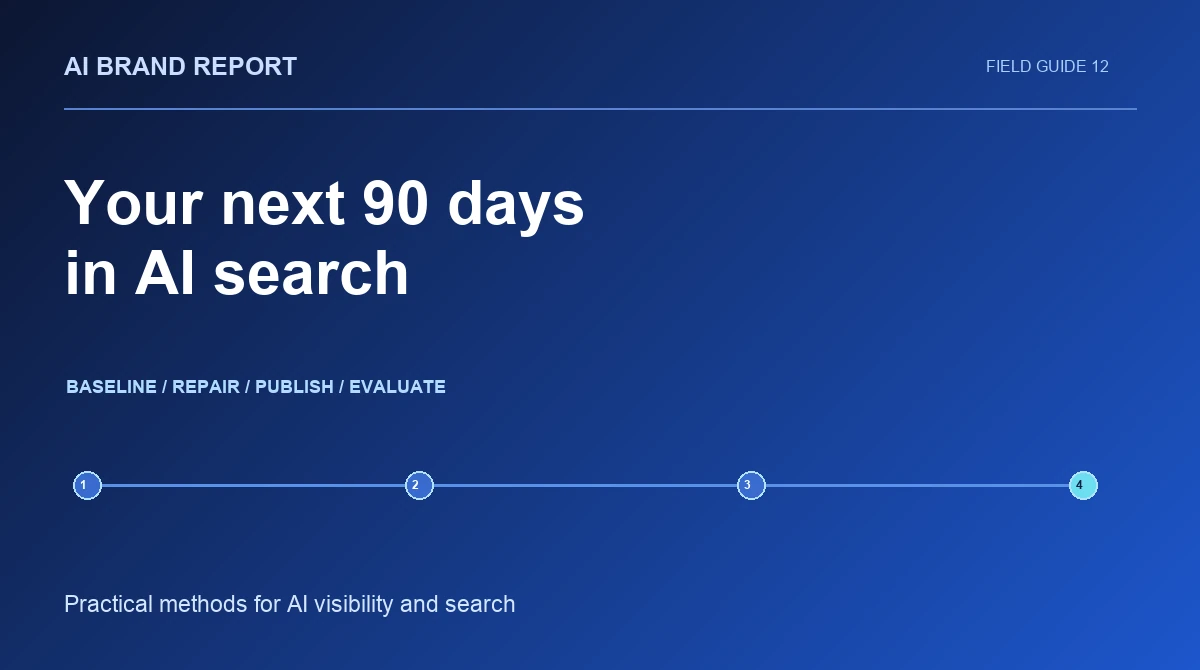
A practical AI search strategy combines a credible baseline, accurate public evidence, useful buyer content, and disciplined evaluation. A 90-day plan gives the work a manageable sequence. It does not guarantee that a search engine or assistant will select your brand within that period.
The strategic question is not how many AI-focused articles you can publish. It is which information gaps keep relevant buyers from understanding, evaluating, or choosing your business, and how you will know that those gaps have improved.
This plan brings together the methods in our July-to-October editorial series. Adapt the workload to your team rather than treating every deliverable as a universal requirement.
Define the outcome before the calendar
Choose a business-relevant objective: improve accuracy for a critical capability, become easier to evaluate in a specific category, or identify the sources that repeatedly shape a competitor comparison.
Then define the evidence you will collect. A baseline might include a stable prompt panel, representative answer reviews, source checks, and verified traffic measures. Avoid an objective that depends on a metric your team cannot actually observe.
Assign one program owner and name the people responsible for product facts, content, technical checks, and measurement. A plan without owners often turns into a list of articles waiting for approval.
Weeks 1–2: Establish the baseline
Collect real buyer questions and build a prompt research matrix. Separate unbranded discovery, branded evaluation, and named comparisons. Record engines, modes, dates, and failure handling.
Review the existing content library before creating a new calendar. Identify the pages that already answer the relevant questions and the ones that overlap. Check whether the product's most consequential facts are current.
Deliverables for this phase:
- A versioned prompt panel and measurement definitions.
- A baseline answer set with visible sources retained.
- A short list of high-impact information gaps.
- An owner and acceptance check for each gap.
The finish line is a baseline another person can understand and repeat, not a large scorecard with unexplained numbers.
Weeks 3–4: Repair access and factual gaps
Run a focused crawler access audit on the pages that matter. Resolve demonstrated delivery or indexing problems through the normal technical review process.
Create or improve a brand facts reference. Reconcile contradictory product descriptions, plan restrictions, service areas, or integration claims. Prioritize mistakes that could lead to a wrong purchase decision.
Perform a citation audit on recurring source links. Separate factual errors from editorial opinions and identify which sources you can update directly.
By the end of this phase, the public evidence should be more accurate and easier to inspect. Do not wait for a favorable AI answer before recognizing a verified correction as completed work.
Weeks 5–8: Publish decision-focused content
Choose a small number of content projects based on the gaps found. Possible deliverables include a comparison page, an implementation guide, a revised product explanation, or a location-specific resource.
Use the refresh decision framework to decide whether to update an existing page or create a new one. Avoid publishing multiple pages for essentially the same intent.
Every brief should specify the buyer question, evidence required, distinctive contribution, and useful next step. Give the writer access to a product expert rather than asking them to infer capabilities from marketing slogans.
| Content project | Useful contribution | Acceptance check |
|---|---|---|
| Comparison page | Criteria and tradeoffs for a defined audience | Claims have sources and scope |
| Implementation guide | Steps, prerequisites, and realistic limitations | A reader can identify the work involved |
| Product explanation | Clear capability and availability information | It agrees with current documentation |
| Original analysis | Transparent method and bounded findings | Inputs, assumptions, and limitations are disclosed |
Follow the comparison-page guide when the buyer is choosing between options. For retailers, prioritize product-data consistency. For distributed businesses, use a location-aware audit.
Weeks 9–10: Repeat comparable observations
Run the stable panel again and review coverage before interpreting changes. Keep a log of what shipped and when. Annotate provider, model, mode, or prompt changes that affect comparability.
Use the experiment design framework to distinguish observations from causal claims. Inspect representative answers, including unresolved problems, rather than selecting only the most favorable examples.
Connect the findings to observable referrals and useful actions. Do not combine tested answers, website sessions, and customer counts into a funnel unless they are actually connected under a defined method.
Weeks 11–12: Decide what to scale
Review the program against its original objective. Which factual gaps are resolved? Which pages now answer important questions well? Which changes have encouraging but still limited evidence? Which assumptions were wrong?
Use three dispositions:
- Scale: the work is useful, repeatable, and supported by enough evidence for the next investment.
- Continue observing: the work is complete but the outcome remains uncertain.
- Stop or revise: the hypothesis was weak, the audience was wrong, or the work did not solve the intended problem.
Reserve the final days of the 90-day window for documenting decisions and assigning the next cycle. The most useful output may be a shorter, better-prioritized backlog.
Avoid shortcuts that create activity without value
Do not buy a promise of guaranteed AI recommendations. Do not invent customer results, publish unsupported competitor claims, or create near-duplicate articles simply to occupy more keywords.
Use structured data where it accurately describes visible content. Google has retired FAQ rich results, according to its Search documentation updates. FAQs can still serve readers, but a rich-result promise should not be part of the business case.
Likewise, publishing more frequently is not itself proof of product progress or thought leadership. Distinctive expertise appears in the explanation, method, evidence, and judgment the reader can use.
Frequently asked questions
What should an AI search strategy prioritize first?
Start with the buyer decisions you want to support, a documented measurement baseline, and accurate accessible product information. Use the findings to choose content and source improvements.
Is 90 days enough to guarantee AI visibility growth?
No. Ninety days is a planning window for completing and evaluating work, not a guarantee of indexing, citations, traffic, or revenue.
Does adding FAQ schema guarantee better AI visibility?
No. Useful visible answers can help readers, but markup does not guarantee AI selection. Google has also retired FAQ rich results, so they should not be promised as a benefit.
Start with the evidence available today
Get your free AI visibility report and use it to identify questions worth investigating. Build the next 90 days around useful evidence, a clear owner, and a measurable finish line. If you report to clients or leadership, use our AI visibility reporting structure to keep the decisions clear.