The AI Perception Problem
AI Brand Report ·
AI engines shape first impressions before your website ever loads. If you're not monitoring what they say about you, you're not managing your reputation. Here's how to audit all three layers.
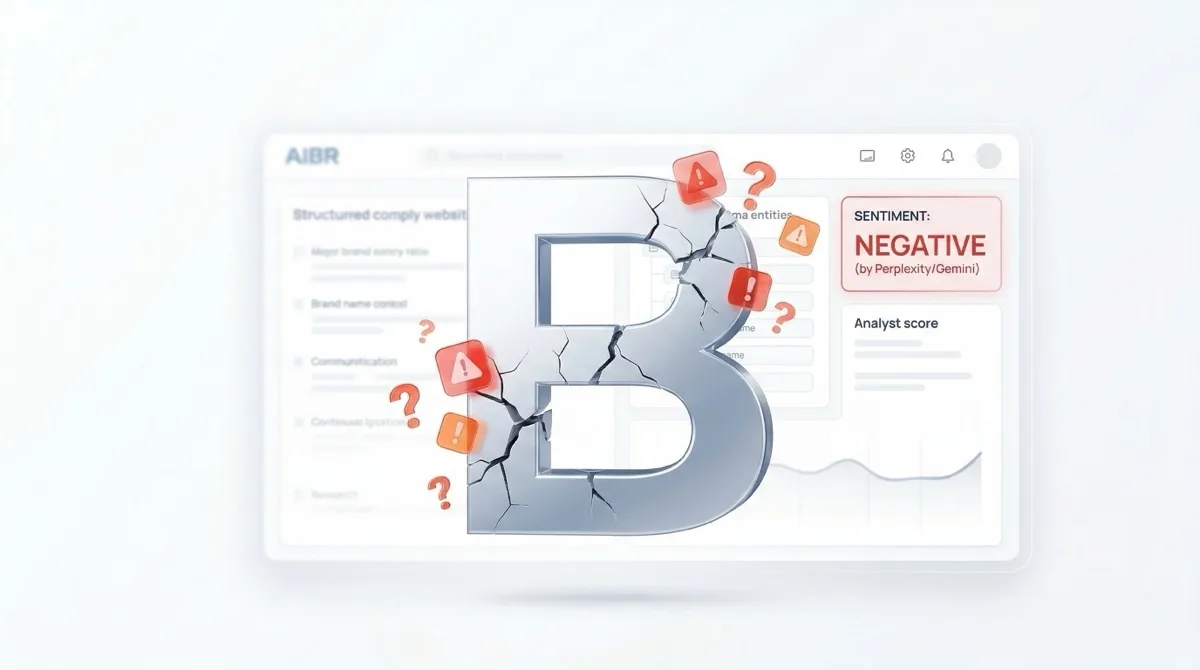
The first impression you're not writing
AI engines now shape first impressions before your website ever loads. Buyers ask ChatGPT, Perplexity, and AI-powered search overviews what to choose. They receive synthesized summaries, comparison lists, and direct recommendations. Many accept these outputs at face value.
If you're not monitoring what AI says about you, you're not managing your reputation.
Perception is no longer formed slowly through advertising and PR cycles. It forms instantly from synthesized information-information that can be accurate, outdated, incomplete, or quietly biased toward competitors with stronger digital signals. The distinction that matters is not whether AI is describing your brand. It is. The question is whether you know what it's saying.
Layer 1: Presence (inclusion)
Before tone or narrative matter, inclusion matters.
If someone asks "Best CRM tools for small businesses" and your brand doesn't appear in the answer, you have a visibility gap. Buyers who never see your name in the shortlist can't evaluate you, regardless of how strong your positioning is for those who do find you.
Ask:
- Are we mentioned in AI-generated answers at all?
- Are competitors cited more frequently than we are?
- Are we present in high-intent category queries?
- Do we appear in "best for X" responses relevant to our actual market?
Absence is the most fundamental problem-and the most frequently overlooked. Teams often assume that if they're ranking in traditional search, they're visible in AI outputs. The two don't always align.
Start here. No inclusion means no consideration. Fixing tone and narrative becomes irrelevant if you're not in the answer to begin with.
Layer 2: Sentiment (tone)
When your brand appears in AI-generated answers, the next question isn't just whether you're included-it's how you're framed.
Tone is subtle. It doesn't always appear as explicit praise or criticism. It shows up in the specific words and qualifiers attached to your brand across repeated queries.
Common perception drift shows up as descriptors like:
- "Expensive" or "premium pricing"
- "Complex" or "steep learning curve"
- "Only for enterprises" or "not ideal for smaller teams"
- "Beginner-friendly" (when you don't target beginners)
- "Hard to implement" or "requires technical expertise"
- "Limited integrations" or "niche use cases"
These phrases appear neutral on the surface. They're not.
If your competitors are simultaneously described as "flexible," "scalable," "user-friendly," and "highly rated," even slightly more positive framing creates preference bias-before a single feature comparison has been made.
Tone influences three outcomes in particular:
- Trust - Does the description reduce or increase risk perception?
- Confidence - Does the language feel decisive or hedged?
- Willingness to pay - Are you framed as valuable, or as a risk requiring justification?
Neutral framing can be as damaging as negative framing. If you're described in flat, factual language while competitors receive confident endorsements, momentum shifts toward them-quietly, and without any single negative statement about you.
Consider the difference:
- Competitor A: "A powerful, easy-to-use platform trusted by thousands of businesses."
- Your brand: "A software tool designed for mid-sized teams."
Neither is factually wrong. But one inspires confidence. The other invites hesitation.
That difference compounds across dozens of queries and thousands of impressions. Tone drift happens quietly. It rarely triggers alarms. But over time, it affects close rates, deal velocity, and perceived authority.
Layer 3: Narrative (themes and attributes)
Narrative is deeper than tone.
Tone describes how you're described. Narrative describes what themes consistently define you-the recurring attributes, associations, and implied audiences that appear across many different queries and contexts.
Narrative answers questions like:
- What recurring words are attached to your brand?
- What objections appear even when the query isn't about objections?
- What audience is implied when your brand is mentioned?
- Are you consistently framed in a category you no longer occupy?
- Are competitors positioned as "innovative" while you're labeled "established"?
These patterns shape category identity. If competitors are consistently framed as:
- Innovative, modern, AI-powered, rapidly growing
And you are framed as:
- Reliable, traditional, longstanding, established
The market slowly interprets this as: they lead, you follow.
Narrative is not random. It's assembled from your digital footprint-reviews, blog posts, comparison articles, community threads, your own website content, and the sources that reference you. It reflects the weight of available signals.
The important implication is that narrative is adjustable. If pricing is repeatedly emphasized, it usually means value framing content is insufficient. If complexity is a recurring theme, onboarding and implementation content needs work. If you're excluded from "best for" queries, your authority footprint isn't strong enough for those use cases. Each pattern points to a specific corrective action.
Why unmonitored narratives compound
If AI repeatedly frames you in ways that don't serve you, that framing spreads and hardens.
It appears in:
- Search summaries and AI overviews
- "Best of" lists and comparison roundups
- Community threads and discussion forums
- Sales enablement conversations buyers have before engaging you
Buyers often assume AI summaries are objective. When a theme is repeated across platforms, it feels true-even if it originated from outdated or weak sources. This is how perception becomes entrenched.
Unmonitored AI narratives compound because:
- AI systems reference similar authoritative sources, reinforcing each other
- Repetition strengthens confidence in synthesis
- New content layers on top of existing signals without displacing them
- Drift becomes reinforced reality before anyone notices the revenue impact
By the time the narrative effect is visible in close rates or pricing pressure, it may already be deeply embedded.
A practical starting point
Structure beats complexity. Start by testing 15–20 high-intent queries relevant to your category.
Example queries:
- "Best [category] tools for small businesses"
- "[Category] software comparison"
- "Is [your brand] worth it?"
- "Alternatives to [competitor]"
- "[Your brand] vs [top competitor]"
For each query, document:
| Data point | Why it matters |
|---|---|
| Inclusion frequency | Are you in the answer at all? |
| Position in lists | Are you leading or trailing? |
| Tone descriptors | What adjectives are used for you vs competitors? |
| Attribute comparisons | What strengths and weaknesses are emphasized? |
| Audience framing | Who does AI imply your product is for? |
Repeat monthly. Look for shifts in tone, new recurring themes, competitor narrative gains, and changes in inclusion frequency.
Perception drift is measurable. What's measurable is manageable.
Takeaway
If you don't audit AI perception, external systems will position you without oversight-synthesizing available signals into a narrative you didn't design and may not be aware of.
- Visibility matters - are you included?
- Tone matters more - how are you described?
- Narrative determines preference - what themes define you over time?
The brands that monitor all three layers will catch drift early. The brands that don't will discover it in their revenue data.
FAQ
How often do AI systems update their understanding of a brand?
It varies significantly by platform. Perplexity uses live retrieval from the web and tends to reflect new content within days of indexing. Closed-model systems like ChatGPT update on training cycles, which can mean weeks or months before new signals consistently appear in outputs. Running tests monthly gives a reliable baseline for most platforms.
What if the AI description of my brand is factually wrong?
The practical path is improving the source material AI draws from, not requesting corrections directly. When cleaner, more authoritative, and better-structured content exists, AI uses it. Some platforms accept feedback submissions, but source improvement is both more reliable and more durable. Wrong AI descriptions typically originate from outdated reviews, old blog posts, or thin owned content-all of which can be addressed.
Should I be worried if competitors describe themselves using my keywords?
It's common and worth monitoring. If a competitor's positioning page uses language that closely mirrors yours, AI may blend or conflate your positioning in comparison outputs. The response is differentiation through specificity: more precise descriptions, more concrete proof points, and clearer audience targeting make your brand harder to conflate.
Can a small brand build enough authority to appear in AI recommendation lists?
Yes. Authority in AI contexts isn't solely about domain size or budget-it's about the clarity and consistency of positioning, the quality of structured content, and the presence of credible third-party signals (reviews, media mentions, backlinks). A small brand with excellent case studies, clear comparison pages, and strong reviews can outperform a larger competitor with vague or inconsistent content.
Check Your AI Visibility
If you want to see how AI systems describe and recommend your brand today, start with a free AI visibility report. AI Brand Report checks your presence across major AI engines, compares your visibility against competitors, and highlights the gaps most worth fixing first.
Get your free AI visibility report.