How to Fix a Negative AI Narrative
AI Brand Report ·
If AI keeps calling your brand 'expensive,' 'complex,' or 'not for us,' that's not a product problem-it's a narrative problem. Here's a five-step plan to identify it, trace it, and fix it.
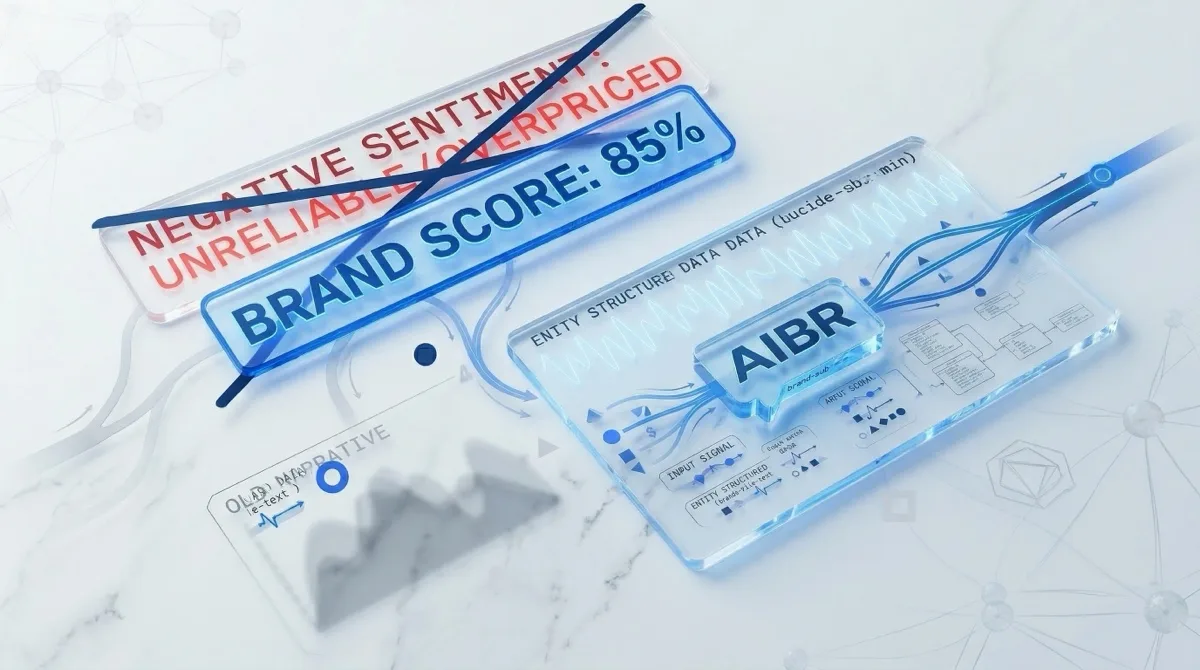
The problem with negative AI narratives
When AI tools consistently describe your brand as "expensive," "complex to implement," or "not designed for our type of business," the damage is real-even if the description is wrong.
Buyers form first impressions from AI summaries before they ever visit your website. If those summaries carry unfavorable framing, you're starting every sales conversation at a disadvantage. Your sales team handles objections your positioning never put there. Your pipeline quality suffers. And the marketing spend driving traffic arrives pre-loaded with doubt.
Here's what matters: negative AI narratives are not permanent, and they're not random. They're signals with traceable sources-and that means they're fixable.
Why AI says what it says
AI tools don't invent descriptions. They synthesize patterns from across the web:
- Review platforms (G2, Capterra, Trustpilot, Google Reviews)
- Blog posts, comparison articles, and roundups
- Community discussions on Reddit, Slack groups, industry forums
- News articles and press coverage
- Your own website content-including pricing pages, FAQs, and positioning copy
If those sources consistently use certain language about your brand, AI repeats it. The most frequently occurring themes across the most authoritative sources become your AI narrative.
The implication: To change what AI says, you change what those sources say-by improving your own content and strengthening the signals AI trusts.
Step 1: Identify the exact problem
Vague awareness of "AI being negative" is not actionable. Specific language is.
Test your brand across multiple AI tools and queries:
- "What is [your brand]?"
- "Best [your category] tools"
- "[Your brand] vs [competitor]"
- "Is [your brand] worth it?"
- "[Your brand] reviews"
Document exactly what you find:
| Query | AI tool | Description used | Tone |
|---|---|---|---|
| Best CRM tools | ChatGPT | "Powerful but steep learning curve" | Negative caveat |
| [Brand] vs Competitor | Perplexity | "Better for large enterprises" | Mispositioned |
| Is [Brand] worth it? | Google AI | "Premium pricing, strong features" | Mixed |
From this audit, you'll see patterns. The specific phrases that repeat across queries and tools-those are your targets.
Don't try to fix everything at once. Pick the 1–2 themes that appear most frequently and focus there first.
Step 2: Understand where it's coming from
Once you know the theme, trace its source. AI doesn't generate these descriptions from nothing-it's pulling from somewhere.
Common sources of negative narratives:
Review platforms: A cluster of negative reviews from two years ago mentioning "pricing shock" or "difficult setup" can drive an AI description that outlasts the actual problem by years.
Competitor comparison pages: Third-party "X vs Y" posts often include unfavorable characterizations. If they're well-linked and frequently cited, AI treats them as authoritative.
Forum threads: Discussions on Reddit, Quora, or industry Slack communities can generate surprisingly influential source material for AI, especially if the thread ranks well and received high engagement.
Old blog content: Articles from 2–3 years ago describing your product's limitations may still be indexed, linked, and weighted highly by AI systems-even after you've addressed those limitations.
Your own website: Unclear pricing pages, ambiguous positioning, or a lack of information about specific use cases can lead AI to fill gaps with assumptions that skew negative.
The fix depends on the source. If it's old reviews, the strategy is different than if it's your own positioning content. Identify the source before publishing anything.
Step 3: Publish targeted content
Don't publish more content for its own sake. Publish content that directly addresses the specific negative theme showing up in AI responses.
If the issue is pricing:
- Publish a transparent pricing page that explains what's included and why
- Create an ROI calculator or ROI case study
- Write a "Is [your brand] worth it?" page that directly addresses the cost question
- Add comparison content that contextualizes your price against alternatives
If the issue is complexity:
- Publish a step-by-step onboarding guide with realistic timelines
- Create a "Getting started in [X] minutes" page
- Feature customer stories that specifically mention ease of implementation
- Build a FAQ page around setup, integration, and learning curve questions
If the issue is audience fit ("only for large companies" or "only for beginners"):
- Create explicit use-case content for your actual target segment
- Build a "Who is [your brand] for?" page with clear criteria
- Feature case studies from customers in the mischaracterized segment
- Write comparison content that positions you correctly against segment-specific alternatives
The principle: Give AI clearer signals than the sources currently driving the negative narrative. Well-structured, authoritative content that directly addresses the theme will, over time, compete with and replace the signals that generated the problem.
Step 4: Strengthen trusted sources
AI systems don't weigh all sources equally. They favor content that appears frequently, comes from authoritative platforms, and is consistent across multiple references.
Priority sources to strengthen:
Review platforms: Actively solicit new reviews from satisfied customers. Respond professionally to existing negative reviews. More recent, positive reviews dilute the influence of older negative ones.
Media coverage: Even a handful of credible press mentions improve the authority of your brand's narrative in AI systems. Prioritize publications that AI commonly cites in your category.
Case studies: Structured case studies with specific metrics and outcomes are highly extractable by AI. Include numbers, timelines, and quotes. Put them on your website in clean, crawlable HTML.
Comparison pages: Create your own first-party comparison content. If you don't define how you compare to competitors, third parties will-and their framing may not serve you.
Analyst and directory listings: Ensure your profiles on G2, Capterra, Crunchbase, and category-specific directories are current, complete, and use consistent language.
The key insight: When stronger sources exist, AI narratives shift faster. You don't have to delete the old content driving the problem-you have to outrank it with better signals.
Step 5: Monitor progress
Fixing a negative AI narrative is not a one-time campaign. It's an ongoing process of measuring, adjusting, and verifying.
Track monthly:
- Are the specific negative themes decreasing in frequency?
- Are positive descriptions appearing more often?
- Are you appearing in more category answers overall?
- Which new sources are being cited when AI mentions you?
What progress looks like:
- The phrase "expensive" is replaced by "value-based pricing" or disappears entirely
- AI starts describing your onboarding as "quick to implement" or "easy to set up"
- You appear in queries where previously only competitors were mentioned
- The overall tone shifts from mixed or negative to neutral or positive
Be patient with the timeline. AI perception changes gradually as new content is indexed and new authority signals accumulate. Expect meaningful shifts over 6–12 weeks after publishing targeted content-not overnight.
What to avoid
Publishing vague content: Generic "why we're great" posts won't move the needle. AI needs specific, answer-ready content that directly addresses the concern.
Ignoring the source: If the problem is rooted in old reviews or third-party comparisons, publishing new blog posts won't fix it. Address the actual source.
Measuring too soon: Testing AI responses one week after publishing new content won't reflect any change. Give it time.
Changing your positioning without changing your proof: If AI says you're "hard to use" and you publish messaging claiming "easy to use" without case studies, testimonials, or step-by-step documentation to back it up, the narrative won't shift-and the disconnect between your claims and available evidence may make things worse.
Takeaway
Negative AI narratives are rarely about a bad product. They're almost always about a gap between what you know to be true and what the information online currently says.
When you:
- Measure the narrative - identify the specific themes with precision
- Identify the source - trace where those themes are coming from
- Publish targeted content - address the exact concern, not a general one
- Strengthen your proof - reviews, case studies, comparisons, media coverage
- Monitor over time - track whether the narrative is shifting
You stop reacting to how AI describes your brand and start shaping it.
FAQ
How do I know if my AI narrative has improved?
Re-run the same test queries you used in your initial audit. Compare the descriptions used and note changes in tone, themes, and positioning. Track month-over-month to identify trend direction, not just individual data points.
Can I ask AI tools to remove or correct incorrect information about my brand?
You can submit feedback or corrections to some AI providers, but the more reliable approach is improving the source material AI draws from. When cleaner, more accurate, and more authoritative sources exist, AI will use them.
What if the negative narrative is based on real product limitations?
Transparency works better than avoidance. Acknowledge the limitation clearly, explain who the product is not for, and let the quality of your offering for the right audience speak for itself. Trying to suppress legitimate negative themes without addressing the underlying issue is rarely effective.
How many pieces of content do I need to publish to shift the narrative?
Quality over quantity. Two or three highly authoritative, well-structured pages that directly address the core theme will outperform a dozen vague blog posts. Focus on pages AI is likely to cite: your FAQ, comparison pages, case studies, and pricing/value pages.
Check Your AI Visibility
If you want to see how AI systems describe and recommend your brand today, start with a free AI visibility report. AI Brand Report checks your presence across major AI engines, compares your visibility against competitors, and highlights the gaps most worth fixing first.
Get your free AI visibility report.