Brand Perception vs Brand Awareness: What’s the Difference?
AI Brand Report ·
Awareness is being known. Perception is being chosen. Here’s how to measure each-and why perception is the metric that moves revenue.
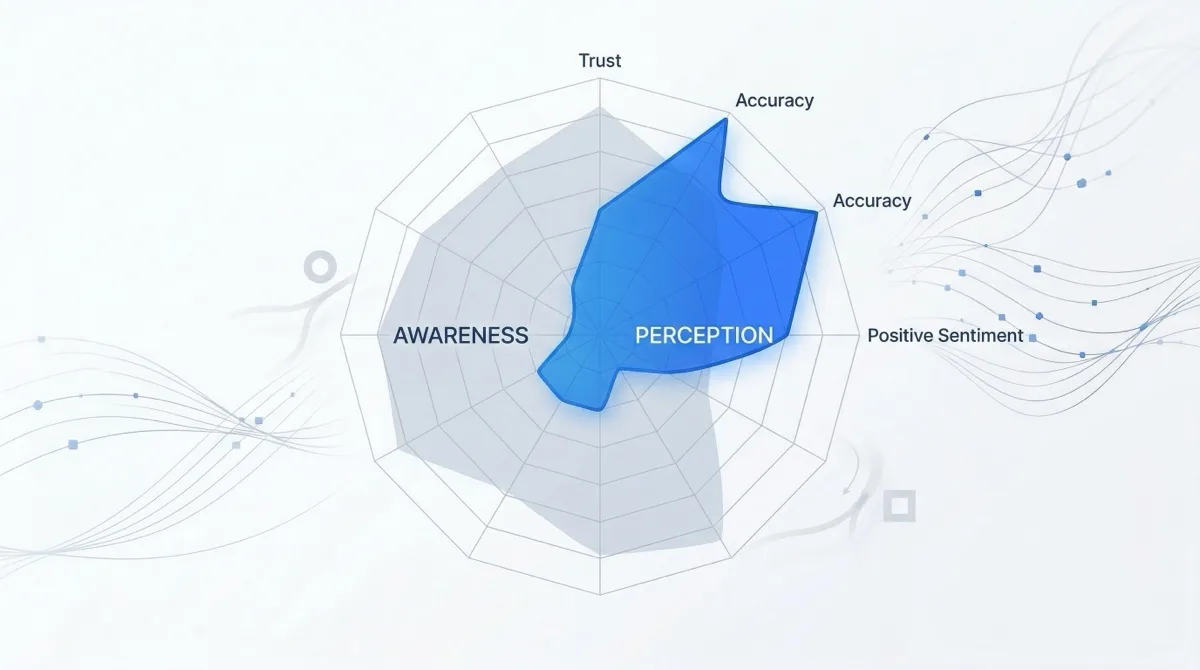
Brand perception vs brand awareness: what’s the difference?
Brand awareness = Do people know you exist? Brand perception = What do they believe about you-and does that belief make them choose you?
Awareness gets attention. Perception creates preference. In today’s landscape-AI answers, search narratives, social conversations, and community forums-perception is the metric most tied to conversion, retention, and pricing power.
Quick comparison
| Brand Awareness | Brand Perception | |
|---|---|---|
| Core question | Do they know us? | What do they believe about us? |
| Predicts | Visibility | Choice, trust, willingness to pay |
| Built by | Reach + repetition | Positioning + proof + experience |
| Measured by | Surveys, impressions, branded search | Sentiment + themes + comparisons |
| Best use | Top-of-funnel | Winning deals + defending margin |
What is brand awareness?
Brand awareness measures recognition and recall.
Typical awareness questions include:
- Have you heard of this brand?
- Can you recognize this logo?
- Can you name brands in this category?
Awareness is usually measured with:
- Surveys
- Reach and impressions
- Share of voice
- Branded search volume
These metrics answer an important but limited question: Are we known? Awareness helps growth, but it doesn’t explain why someone would choose you.
What is brand perception?
Brand perception measures beliefs, associations, and expectations tied to your brand.
It answers questions like:
- Are we seen as premium or overpriced?
- Reliable or risky?
- Innovative or outdated?
- Easy to use or hard to implement?
- Better than competitors-or just “another option”?
Perception forms in places you don’t control:
- AI-generated answers and summaries
- Search snippets, comparisons, and reviews
- Social posts and comments
- Forums and communities (often where objections live)
- Word-of-mouth and customer experience
Unlike awareness, perception directly influences choice, trust, and willingness to pay.
Why awareness without perception is dangerous
High awareness with poor perception can be worse than low awareness.
Examples:
- Everyone knows your brand, but associates it with “expensive and hard to use”
- AI answers mention you, but frame you as “good for beginners, not professionals”
- You rank well in search, but Reddit threads consistently warn people away
In each case, awareness is high-but preference is low. That’s why teams often feel stuck:
“Traffic is up, but pipeline quality isn’t.” “People know us, but still choose competitors.” “Our messaging sounds right, but the market doesn’t repeat it.”
That gap is perception.
Why brand perception matters more now than ever
Historically, perception formed slowly through ads, PR, and word-of-mouth.
Today it forms instantly and externally-often before someone reaches your site:
- They ask ChatGPT, Perplexity, or other AI engines what to buy
- They accept AI-generated comparisons and recommendations at face value
- They scan Google snippets and "best of" lists
- They read communities, reviews, and comparisons
- They form an opinion from the narrative they see repeated
In many categories, the first impression of your brand is no longer written by you. It's written by AI systems synthesizing information from across the web.
The AI Perception Problem
When someone asks an AI engine "What are the best CRM tools for small businesses?", they might get a response that:
- Mentions 3-5 competitors but not your brand
- Describes competitors with positive attributes while framing you as "expensive" or "complex"
- Cites outdated information or common misconceptions
- Ignores your latest features or positioning
If you're not monitoring what AI says about you, you can't fix it.
How to measure brand perception (the practical model)
A useful perception measurement system has three layers:
-
Presence (inclusion) Are you mentioned at all in AI answers, search results, and category conversations? Example: When someone asks "What are the best email marketing tools?", does AI include you in the answer?
-
Sentiment (tone) When you're mentioned, is it positive, neutral, or negative? Example: Does AI describe you as "reliable and easy to use" or "expensive and complex"?
-
Narrative (themes & attributes) What specific words, themes, and beliefs are attached to you (and competitors)? Example: Are you positioned as "best for enterprises" or "good for beginners"? Is pricing a recurring theme? Narrative is the most actionable layer because it tells you what to fix.
Measuring AI Perception Specifically
For AI answer engines, track:
- Visibility: How often you're mentioned vs competitors in category queries
- Sentiment: The tone AI uses when describing you
- Context: When and why AI recommends you vs alternatives
- Sources: Which websites and content AI cites when mentioning you
- Changes over time: How AI knowledge evolves as you improve your digital footprint
The measurement gap: why most teams still miss perception
Many teams think they’re measuring perception, but they’re measuring proxies.
Common mistakes:
- Treating social listening as the whole picture
- Relying only on surveys that lag reality
- Looking at SEO rankings without understanding SERP narrative
- Tracking sentiment without identifying the themes driving it
Perception is multi-channel. If you only measure one channel, you’ll miss drift that starts elsewhere.
Turning perception into action
When perception is clear, teams can:
- For AI engines: Identify queries where you're missing and create content to fill gaps
- For AI engines: Improve the quality and SEO of pages AI cites about you
- For AI engines: Monitor whether AI knowledge improves after content updates or PR
- Adjust messaging to address real objections (not assumed objections)
- Close narrative gaps competitors are winning
- Detect positioning drift early, before it hits revenue
- Prove whether brand initiatives are working over time
Practical Steps for AI Perception
- Baseline: Test 10-20 queries relevant to your business in ChatGPT and Perplexity
- Identify gaps: Find queries where competitors are mentioned but you're not
- Create content: Write high-quality content addressing those gaps
- Optimize existing: Improve SEO and authority of pages you want AI to cite
- Monitor: Re-test monthly to see if AI knowledge improves
- Iterate: Focus on high-impact queries where visibility matters most
The goal isn't more data. The goal is better positioning and faster corrective action.
Takeaway
Brand awareness is about being seen. Brand perception is about being chosen.
In today’s landscape-AI answers, search narratives, social and community discourse-perception is the more powerful, more actionable metric. If you measure perception continuously, you can steer the story instead of reacting to it.
FAQ
Is brand awareness or brand perception more important?
Most brands need both, but perception is more directly tied to conversion and pricing power. Awareness without positive perception often creates attention without preference.
Can you have strong perception with low awareness?
Yes. Niche brands can be highly trusted by a smaller audience. Growth then becomes scaling awareness while protecting the narrative that’s working.
What’s the fastest way to improve brand perception?
Identify the top 2–3 negative themes (e.g., “too expensive,” “hard to implement,” “poor support”), address them with messaging and proof (case studies), and track whether the narrative shifts across channels.
Practical Example
A marketing team can start with a focused baseline: choose 10 to 20 buyer prompts, run them across the major AI engines, and record whether the brand appears, how it is described, and which competitors are recommended instead.
From there, the team can prioritize the highest-impact gaps: unclear positioning, missing comparison content, weak third-party mentions, outdated review signals, or pages that do not answer buyer questions directly enough for AI systems to cite.
Check Your AI Visibility
If you want to see how AI systems describe and recommend your brand today, start with a free AI visibility report. AI Brand Report checks your presence across major AI engines, compares your visibility against competitors, and highlights the gaps most worth fixing first.
Get your free AI visibility report.