Awareness vs. Perception: The Revenue Divide
AI Brand Report ·
Awareness tells you whether people know you exist. Perception tells you whether they'll choose you. In an AI-driven market, the gap between the two is where revenue is won and lost.
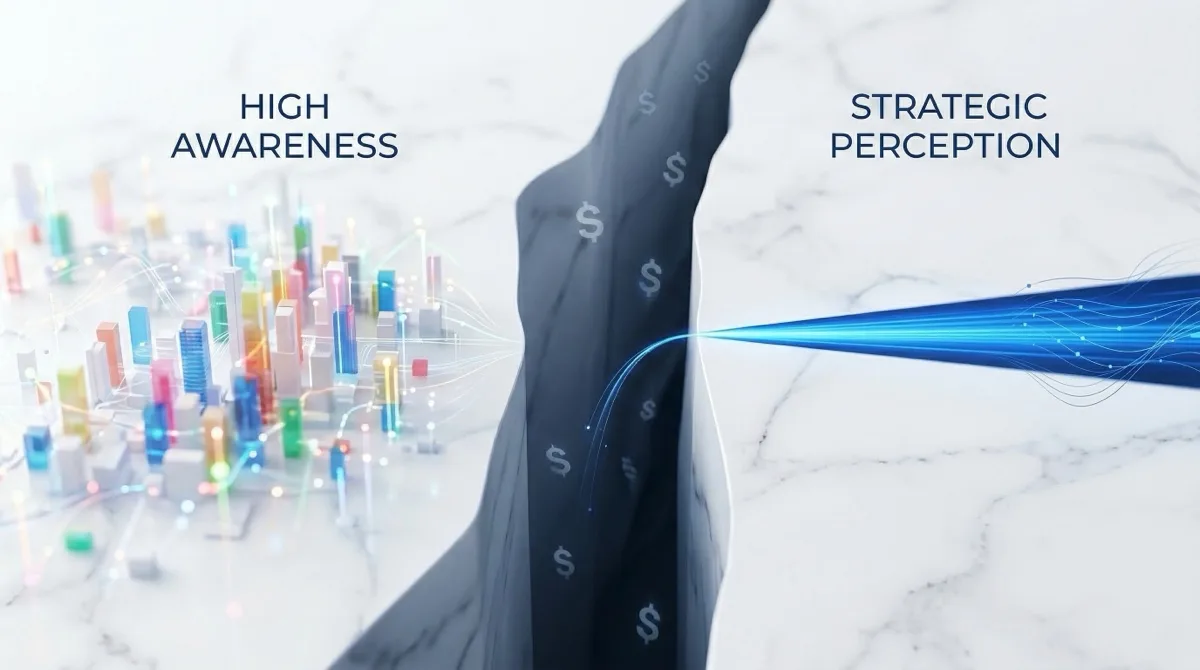
Awareness and perception are not the same metric
Brand awareness asks: Do people know we exist?
Brand perception asks: Do they prefer us-and does that preference make them act?
Awareness fuels reach. Perception fuels revenue. The two are often treated as interchangeable, but they predict entirely different outcomes. You can have high awareness and declining revenue. You can be widely recognized and consistently overlooked at the point of decision.
Understanding that divide-and measuring it-is where most brands find the real leverage.
What awareness measures (and what it doesn't)
Brand awareness tracks recognition and recall:
- Impressions
- Share of voice
- Branded search volume
- Survey recognition scores
These metrics answer one question well: Are we known?
What they don't answer is whether that recognition translates into preference, trust, or action. A brand can dominate share of voice in its category while consistently losing deals to a less-visible competitor with stronger perception. The traffic is there. The pipeline isn't.
Awareness is a necessary condition for growth. It is not a sufficient one.
What perception measures
Perception measures beliefs, expectations, and associations-the mental model buyers form about your brand before they make a decision.
Questions perception answers:
- Are we seen as premium or overpriced?
- Reliable or risky?
- Innovative or the safe, outdated choice?
- Easy to adopt or hard to implement?
- The obvious choice-or just another option?
Perception forms in places you don't directly control:
- AI-generated answers and comparison lists
- Search summaries and "best of" roundups
- Review platforms and community forums
- Word-of-mouth and earned media
- Competitor content that frames your brand in contrast
Unlike awareness, perception directly predicts conversion, retention, and margin.
The revenue divide: where the gap shows up
High awareness without strong perception creates a specific and identifiable pattern of revenue friction. It tends to appear as:
| Symptom | What it signals |
|---|---|
| Traffic rises but pipeline quality drops | Recognition without preference |
| You rank well but competitors close deals | Awareness without trust |
| Prospects know the brand but hesitate to commit | Familiarity without confidence |
| Pricing objections appear early and often | Perceived value gap |
| Deal cycles lengthen without a clear reason | Unresolved narrative friction |
Each of these symptoms has the same root: buyers recognize the brand but haven't formed a strong enough belief to act confidently. They're aware. They're not convinced.
The divide is not between known and unknown. It's between known and chosen.
Why the gap is more dangerous now
Historically, perception formed over time-through advertising, PR cycles, word-of-mouth, and direct experience. There was opportunity to course-correct before beliefs hardened.
Today, perception forms before a buyer ever visits your website.
By the time they click, they've already:
- Asked AI for a category recommendation
- Reviewed a synthesized comparison from ChatGPT or Perplexity
- Scanned search summaries and "best of" lists
- Read community threads from other buyers
- Formed an opinion based on the narrative they encountered repeatedly
In that environment, the gap between awareness and perception narrows faster-and compounds faster. An AI system that frames your brand as "feature-rich but complex" will repeat that framing across dozens of queries, thousands of times, before you notice it's happening.
Awareness metrics won't tell you this is occurring. Only perception measurement will.
Closing the revenue divide
Closing the gap requires measuring both sides deliberately.
Awareness measurement (you likely already have this):
- Share of voice
- Branded search volume
- Impression data
- Aided and unaided recall surveys
Perception measurement (the part most teams skip):
- AI inclusion rates in high-intent category queries
- Tone and descriptive language in AI and search outputs
- Recurring themes and attributes attached to your brand vs competitors
- Review sentiment patterns across platforms
- Community narrative tracking
The goal is not to maximize awareness at the expense of perception, or vice versa. It's to ensure that the recognition you've built is supported by a narrative that converts it into preference.
When those two things align-when people know you and trust you-awareness becomes leverage.
Takeaway
Awareness gets you seen. Perception gets you selected.
In an AI-driven discovery environment, the moment of first impression has moved upstream. Buyers form views about your brand from synthesized summaries, comparison outputs, and recommendation lists-often before any direct engagement with your content or sales team.
Brands that measure and manage perception alongside awareness will control how they're framed at the critical moment of evaluation. Brands that track only awareness will watch recognition accumulate without the revenue growth it should produce.
Visibility creates opportunity. Narrative determines whether it converts.
FAQ
Can a brand have strong perception with low awareness?
Yes. Highly trusted niche brands often have strong perception within a specific audience before they've achieved broad market awareness. The strategy then becomes scaling recognition while protecting the narrative that's already working-not rebuilding perception from scratch.
Is share of voice a perception metric?
Share of voice is an awareness metric-it measures how often your brand is mentioned relative to competitors, not how it's framed. Perception requires analyzing the content of those mentions: the tone, the attributes, the context. High share of voice with consistently cautious or negative framing is a warning sign, not a success signal.
How quickly can perception shift once you address it?
Meaningful shifts typically take 6–12 weeks after targeted content is published and authority signals are strengthened. AI systems update as new sources are indexed. The more authoritative and structured the new content, the faster the narrative adjusts.
What's the first thing to fix if the gap is visible in revenue data?
Start with the most frequently repeated negative or neutral theme in AI and search outputs. That's where perception is creating the most friction. A single well-structured, authoritative piece of content that directly addresses that theme will move more than a broad content effort spread across multiple topics.
Practical Example
A marketing team can start with a focused baseline: choose 10 to 20 buyer prompts, run them across the major AI engines, and record whether the brand appears, how it is described, and which competitors are recommended instead.
From there, the team can prioritize the highest-impact gaps: unclear positioning, missing comparison content, weak third-party mentions, outdated review signals, or pages that do not answer buyer questions directly enough for AI systems to cite.
Check Your AI Visibility
If you want to see how AI systems describe and recommend your brand today, start with a free AI visibility report. AI Brand Report checks your presence across major AI engines, compares your visibility against competitors, and highlights the gaps most worth fixing first.
Get your free AI visibility report.