How to Shift from Awareness Metrics to Revenue-Driven Perception
AI Brand Report ·
Impressions and share of voice measure exposure. They don't measure how you're framed before buyers decide. Here's what to track instead-and how to connect it directly to revenue outcomes.
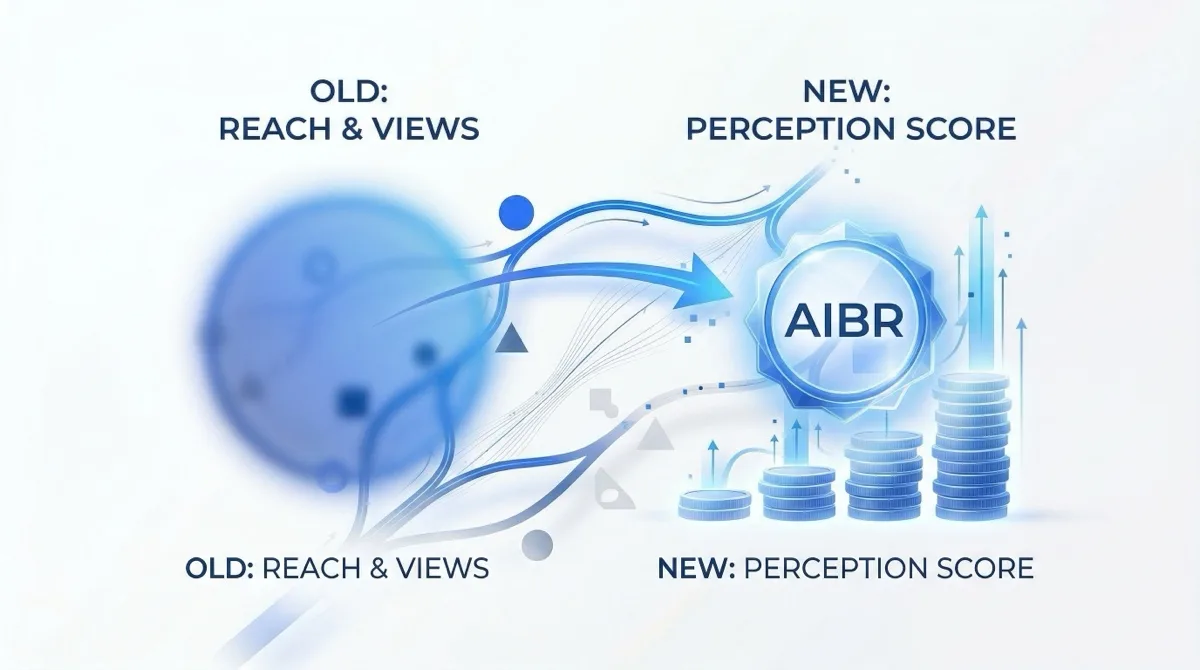
Why the shift is necessary
In a pre-AI world, awareness was the primary growth lever. More impressions meant more traffic, more traffic meant more opportunity, and more opportunity meant more revenue. The equation was linear and relatively reliable.
That equation no longer holds.
Today, awareness without strong perception creates friction in the buying journey. You can be widely recognized and frequently overlooked. You can rank well and still lose deals. You can dominate impressions and still face consistent pricing pressure.
The shift required is simple but uncomfortable:
Stop measuring only who sees you. Start measuring how you're framed before they choose.
Why awareness metrics fall short
Buyers increasingly form opinions before they visit your website. By the time they reach your homepage, they've likely:
- Asked AI engines for category recommendations
- Scanned search summaries and comparison lists
- Read community threads and review platforms
- Accepted a synthesized narrative at face value
If your dashboards only track impressions, share of voice, reach, and branded search volume-you're measuring exposure, not influence. Exposure tells you how many people saw you. Perception tells you what they believed when they did.
The problem with acting only on awareness data is that it leads to awareness-only solutions: more content, more ads, more reach. None of that changes the narrative that's already forming upstream.
What to measure instead
Shifting to revenue-driven perception means prioritizing the signals that shape buyer preference before direct engagement.
1. Inclusion in AI-generated responses
Inclusion determines consideration. If you're not in the shortlist, you're not in the decision.
Questions to ask:
- Are we mentioned in high-intent category queries?
- Do we appear in "best tools for…" responses?
- Are we included in competitor comparison outputs?
- Do we surface in pricing-related searches?
Track:
- Mention frequency vs competitors
- Position in recommendation lists
- Query types where competitors dominate and you don't
- Changes in inclusion month over month
No inclusion means no shortlist. Awareness built elsewhere becomes irrelevant at the decision stage if you're absent from the queries buyers use to evaluate options.
2. Sentiment themes
When you're mentioned, how are you described?
Capture the language patterns:
| Descriptor type | Examples |
|---|---|
| Positive | "Innovative," "scalable," "trusted," "easy to use" |
| Neutral | "Designed for," "offers features for," "suitable for" |
| Negative | "Expensive," "complex," "limited integrations" |
| Risk signals | "Hard to implement," "best for advanced users only" |
Then compare your framing side-by-side with competitors. The difference is often less about what's said and more about the confidence behind it.
For example:
- Competitor: "A powerful, easy-to-use platform trusted by growing teams."
- Your brand: "A software solution designed for mid-sized organizations."
Neither description is inaccurate. But one inspires preference. The other inspires hesitation.
Tone influences trust, willingness to pay, deal confidence, and sales cycle velocity. Even neutral framing weakens your position when competitors receive more confident endorsements.
3. Competitive comparisons
Perception is rarely formed in isolation-it's formed in contrast.
Audit how you're positioned relative to competitors:
- Premium or overpriced?
- Specialized or limited?
- Established or outdated?
- Flexible or complex?
Track:
- Where you're recommended vs where competitors are preferred
- Which differentiators AI emphasizes in your favor
- Which weaknesses are repeated across queries
- How often competitors are recommended while you're absent
AI-generated comparisons compress evaluation cycles. If competitors own the comparison narrative, they control the decision frame before a buyer ever engages with your sales team.
4. Recurring objections
This is where perception turns directly into measurable revenue friction.
Look for repeated themes such as:
- "Too expensive"
- "Hard to implement"
- "Limited integrations"
- "Only good for enterprises"
- "Better alternatives exist for this use case"
Then evaluate whether these objections are supported by current reality-or by outdated sources:
- Is pricing explained transparently on your website?
- Are implementation timelines addressed in your content?
- Do case studies clearly demonstrate value for the objected use cases?
- Are proof points structured and visible, or buried?
Recurring objections are the most actionable perception signal. They tell you exactly where the narrative is creating revenue friction-and exactly what content needs to exist to address it.
Tie perception metrics to revenue outcomes
Perception metrics should not exist in isolation from business performance. The goal is correlation that validates the model and focuses investment.
| Perception metric | Revenue indicator to correlate |
|---|---|
| Inclusion rate in category queries | Pipeline quality and volume |
| Positive sentiment trend | Close rate improvement |
| Reduced pricing objection frequency | Margin strength |
| Improved comparison positioning | Win rate vs specific competitors |
| Elimination of key negative themes | Shortened sales cycles |
If perception improves, revenue indicators should follow. If they don't, the model needs refinement-either the metrics aren't capturing the right signals, or the content changes aren't reaching the right queries.
The objective is not more data. It's alignment between narrative and growth.
Takeaway
Awareness gets you seen. Perception gets you selected.
In AI-driven discovery, visibility creates opportunity-but narrative determines whether that opportunity converts. The brands that measure perception continuously can steer the story. The brands that focus only on awareness risk being widely known and rarely chosen.
When you shift from tracking exposure to tracking influence:
- Measure inclusion - are you in the shortlist?
- Audit sentiment - how are you described when you appear?
- Track comparisons - how do you stack up in AI-generated contrasts?
- Identify objections - where is perception creating friction?
- Correlate with revenue - is the narrative moving the numbers?
Managed perception builds durable competitive advantage. Unmanaged, it compounds into revenue drag you'll struggle to trace back to its source.
FAQ
Isn't share of voice a good proxy for perception?
Share of voice tells you how often you're mentioned-not how you're framed. High share of voice with consistently cautious or negative framing is a warning sign. The two metrics answer different questions and need to be tracked separately.
How do we get leadership to prioritize perception measurement over traditional KPIs?
The most effective approach is to connect existing revenue symptoms to perception causes. If the team is experiencing longer sales cycles, pricing pressure, or declining pipeline quality, trace those back to specific narrative patterns. When leadership can see that "expensive and complex" is appearing in AI responses for high-value category queries, the case for measurement becomes concrete rather than theoretical.
Do perception metrics require special tools?
A basic version requires only time: run the same 15–20 queries monthly in two or three AI platforms, document the language used, and track changes. Dedicated AI brand monitoring tools automate this at scale and provide trend data, competitive benchmarking, and source attribution-but the manual baseline is enough to identify the most urgent issues and demonstrate the value of systematic measurement.
How do we know if our content changes are working?
Re-run your baseline queries 6–8 weeks after publishing targeted content. Look for: reduced frequency of the negative theme, more confident or positive framing in AI outputs, appearance in queries where you were previously absent. These are the leading indicators. Revenue correlation follows but lags behind narrative change.
Practical Example
A marketing team can start with a focused baseline: choose 10 to 20 buyer prompts, run them across the major AI engines, and record whether the brand appears, how it is described, and which competitors are recommended instead.
From there, the team can prioritize the highest-impact gaps: unclear positioning, missing comparison content, weak third-party mentions, outdated review signals, or pages that do not answer buyer questions directly enough for AI systems to cite.
Check Your AI Visibility
If you want to see how AI systems describe and recommend your brand today, start with a free AI visibility report. AI Brand Report checks your presence across major AI engines, compares your visibility against competitors, and highlights the gaps most worth fixing first.
Get your free AI visibility report.