AI SEO vs Traditional SEO: What's the Difference?
AI Brand Report ·
Ranking on Google used to be the goal. Now you also need to be mentioned, cited, and described accurately inside AI-generated answers. Here's what changed-and what to do about it.
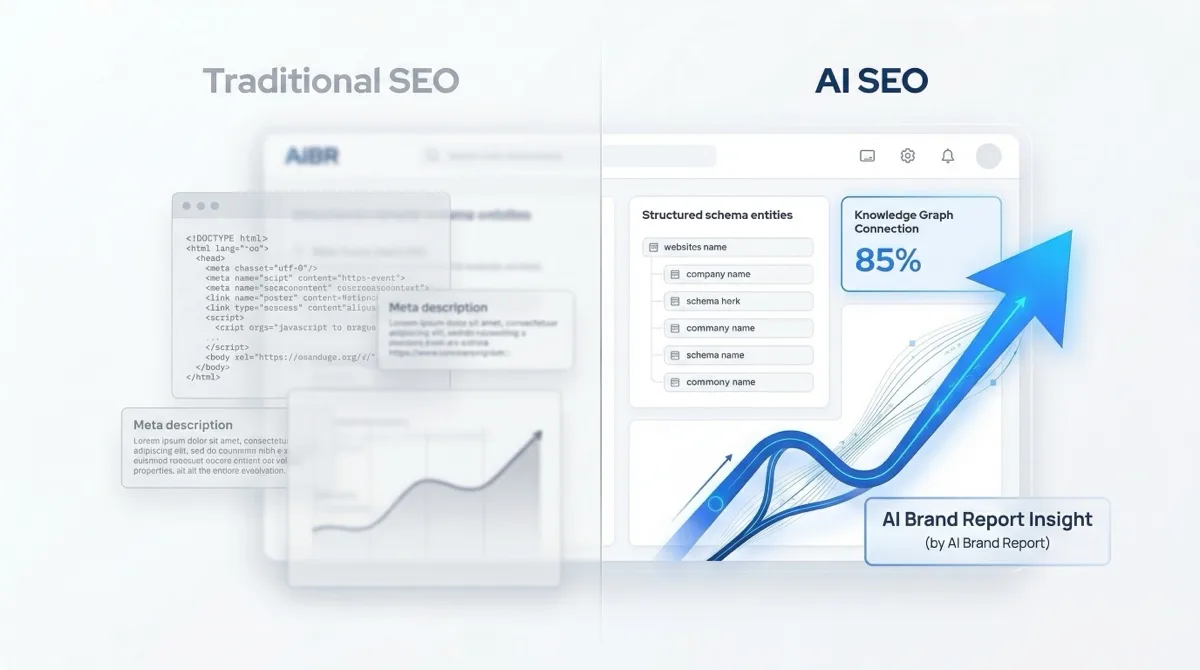
AI SEO vs traditional SEO: what's the difference?
Traditional SEO = Get found in search results. AI SEO = Get mentioned, cited, and described accurately in AI-generated answers.
Traditional SEO still matters. But in today's landscape-where millions of people ask ChatGPT, Perplexity, and AI-powered search overviews what to buy before they ever visit a website-ranking alone is no longer enough. The new question isn't just "Do we rank?" It's "What does AI say about us?"
The funnel has changed
The classic search funnel looked like this:
Search → Click → Website → Buy
That model rewarded rankings. Rank higher, get more clicks, drive more traffic, win more business.
But a growing share of searches now follow a different path:
Ask AI → Read summary → Decide → Maybe visit website
In this new funnel, the moment of influence happens before the click. AI tools contextualize, summarize, and recommend-often without showing a traditional results list at all. If your brand isn't in the answer, you're invisible at the most decisive point in the buyer's journey.
Quick comparison
| Traditional SEO | AI SEO | |
|---|---|---|
| Core goal | Rank higher in search results | Be mentioned and cited in AI answers |
| Success metric | Rankings, clicks, traffic | Visibility, sentiment, citation accuracy |
| Buyer journey | Search → click → website | Ask AI → summary → decision |
| Key signals | Backlinks, keywords, authority | Content clarity, structure, trustworthiness |
| Measured by | Rankings, organic traffic | AI mention rate, tone, themes |
| Best use | Getting found | Getting chosen |
What traditional SEO focuses on
Traditional SEO is built around three pillars:
1. Rankings Getting your pages to appear near the top of Google and Bing results for target keywords.
2. Clicks Writing titles and meta descriptions that earn the click when someone sees your result.
3. Traffic Converting search visibility into website visits, leads, and revenue.
The tasks that support this are well-established:
- Keyword research
- On-page optimization (titles, headings, meta tags)
- Technical SEO (speed, crawlability, Core Web Vitals)
- Link building and domain authority
- Content creation targeting search intent
This model still delivers real results. Ignoring traditional SEO is a mistake. But it no longer covers the full picture.
What AI SEO focuses on
AI SEO asks a different set of questions:
- Are you mentioned when someone asks AI about your category?
- How are you described-accurately, positively, or with misleading caveats?
- Which competitors appear in AI answers when you don't?
- What sources are shaping AI's understanding of your brand?
- Has AI's narrative about you shifted over time?
The tasks are partly familiar, but with a new layer:
- Monitoring AI answers for brand mentions and competitor mentions
- Tracking repeated themes-the words and phrases AI uses to describe you
- Auditing citation sources-which pages, reviews, and articles AI is drawing from
- Creating citation-worthy content-structured, clear, answer-ready pages
- Improving authority signals-case studies, media coverage, review profiles that AI weights as credible
AI SEO is traditional SEO plus perception tracking.
Why this matters in practice
Consider a buyer searching for a B2B software tool. They ask ChatGPT:
"What are the best project management tools for remote teams?"
AI responds with three recommendations. Your competitor is listed as "easy to onboard and highly rated for distributed teams." You're not mentioned at all.
That buyer may never visit your website. The decision was effectively made inside the AI summary.
Now imagine a different scenario: AI does mention you, but says you're "powerful but complex, better suited to large enterprises." You're a mid-market tool. That description is wrong-but it's now shaping the buyer's first impression.
In both cases, your SEO ranking is irrelevant. The AI answer is the bottleneck.
What AI SEO includes (the full picture)
AI SEO is not a replacement for traditional SEO. It's an extension. Here's how they combine:
Shared foundations:
- Keyword research and content strategy
- Technical SEO and site structure
- Authority building through links and coverage
- High-quality, well-structured content
AI SEO additions:
- Content structured for machine parsing (clear headings, schema markup, FAQ sections)
- Answer-first writing-direct summaries before deep dives
- Monitoring AI answers across ChatGPT, Perplexity, Google AI Overviews, and others
- Tracking sentiment and themes attached to your brand in AI responses
- Identifying citation gaps-queries where competitors appear and you don't
- Strengthening the sources AI relies on (review platforms, comparison pages, media mentions)
How to get started with AI SEO
Step 1: Audit your current AI presence Test 10–15 queries relevant to your business in ChatGPT, Perplexity, and Google's AI Overview. Note where you appear, how you're described, and which competitors consistently show up.
Step 2: Identify the gaps Which queries mention competitors but exclude you? What negative or inaccurate themes appear in descriptions of your brand?
Step 3: Create content that answers AI's questions Write clear, structured pages that directly address common buyer questions. Use headings, lists, and tables. Answer questions explicitly rather than burying information in paragraphs.
Step 4: Strengthen your citation sources Improve the pages AI is likely to pull from: your pricing page, case studies, comparison pages, FAQs, and review profiles.
Step 5: Monitor and iterate Re-test monthly. Track whether your visibility improves and whether the themes AI uses to describe you shift in the right direction.
Takeaway
Traditional SEO helps you get found. AI SEO helps you get chosen.
Both matter. But if you're only optimizing for rankings and ignoring how AI describes you, you're leaving influence on the table at the exact moment buyers are forming opinions. The teams winning today are building for both-ensuring they're visible in results and accurately represented in the AI answers that increasingly drive decisions.
For the bigger picture, our complete guide to AI search optimization vs traditional SEO covers the scope, measurement, and tooling needed to do the work continuously across every major AI engine.
FAQ
Is traditional SEO dead?
No. Traditional SEO still drives substantial traffic and leads. The fundamentals-authority, relevance, technical quality-remain important and actually underpin AI SEO as well. The shift is additive, not a replacement.
How do I know if AI is describing my brand inaccurately?
Test prompts directly in ChatGPT, Perplexity, and Google's AI Overview. Ask "what is [your brand]?" and "best [category] tools"-then check whether your brand appears and what language is used to describe it.
What content formats work best for AI SEO?
Clear hierarchical headings (H1, H2, H3), bulleted lists, comparison tables, FAQ sections with direct answers, and schema markup. AI favors content it can cleanly parse and cite. Avoid long, unbroken paragraphs and text locked inside images.
How long does it take to see improvements in AI visibility?
Typically 4–12 weeks after publishing or improving content, depending on how frequently AI systems update their training data or retrieval indexes. Track month-over-month rather than expecting overnight changes.
Practical Example
A marketing team can start with a focused baseline: choose 10 to 20 buyer prompts, run them across the major AI engines, and record whether the brand appears, how it is described, and which competitors are recommended instead.
From there, the team can prioritize the highest-impact gaps: unclear positioning, missing comparison content, weak third-party mentions, outdated review signals, or pages that do not answer buyer questions directly enough for AI systems to cite.
Check Your AI Visibility
If you want to see how AI systems describe and recommend your brand today, start with a free AI visibility report. AI Brand Report checks your presence across major AI engines, compares your visibility against competitors, and highlights the gaps most worth fixing first.
Get your free AI visibility report.