Agent Optimization: How to Create Content That AI Agents Can Discover, Trust, and Recommend
AI Brand Report ·
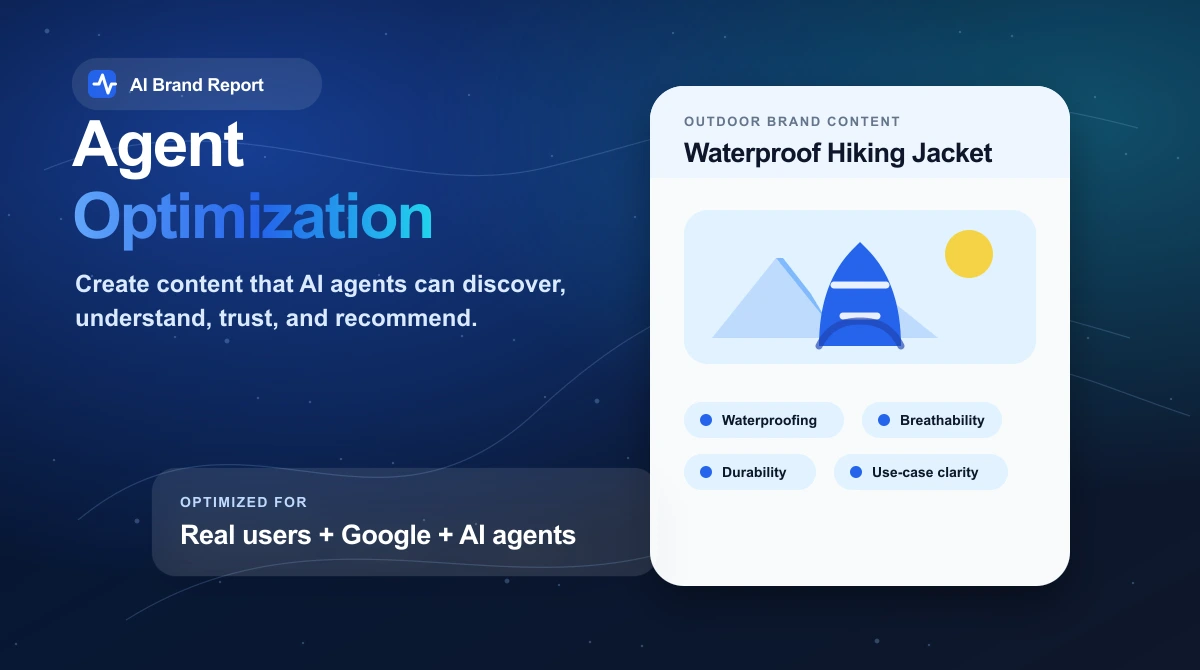
Agent Optimization is the practice of creating content that helps AI agents and LLMs discover, understand, trust, and recommend your brand while still serving Google search and real human readers.
AI search is changing the job of content.
For years, most content strategy was built around a familiar path: rank in Google, earn the click, persuade the visitor, and convert. That path still matters. But it is no longer the only path.
More buyers are now asking AI systems for recommendations, comparisons, summaries, and advice before they ever visit a website. They may ask ChatGPT which vendor to consider, Perplexity which tools solve a problem, Gemini how one company compares with another, or Claude to summarize the pros and cons of a category.
In that environment, your content is not only being read by people. It is being interpreted by AI agents and large language models that decide whether your brand should be mentioned, how it should be described, what sources should support that description, and whether competitors should be recommended instead.
That is where Agent Optimization comes in.
What is Agent Optimization?
Agent Optimization is the practice of creating and structuring content so AI agents, answer engines, and large language models can accurately discover, understand, evaluate, and recommend your brand.
It does not replace SEO. It expands it.
Traditional SEO asks: can a search engine find, crawl, index, rank, and display this page for the right search queries?
Agent Optimization asks additional questions:
- Can AI systems understand what your brand does?
- Can they identify who your product or service is for?
- Can they explain your strengths accurately?
- Can they compare you fairly against alternatives?
- Can they find credible sources that support their answer?
- Can they interpret sentiment, authority, and trust signals correctly?
- Can they recommend your brand when a user asks for help solving the problem you solve?
The goal is not to write for robots instead of people. The goal is to create content that is clear enough for machines to interpret and useful enough for humans to trust.
Why Agent Optimization matters now
AI agents are becoming a new layer between brands and buyers.
A shopper might not search Google for "best waterproof hiking jacket" and click through a list of product pages. They might ask an AI assistant:
- "What jacket should I buy for hiking in cold rain?"
- "Which outdoor clothing brands make waterproof gear that actually lasts?"
- "Is a lightweight rain shell enough for a three-day backpacking trip?"
- "Compare these three outdoor brands and tell me which one is best for wet, windy conditions."
The answer may summarize a category, name specific brands, cite third-party sources, and give the user a recommendation before the user ever visits a website.
That means content now has to support three audiences at once:
- Real users who need useful, credible, persuasive information.
- Search engines that still rely on crawlability, relevance, authority, and page experience.
- AI agents and LLMs that synthesize information across sources and generate answers instead of simply listing links.
If your content is vague, thin, inconsistent, or unsupported by credible external references, AI systems may ignore it, misunderstand it, or describe your brand in ways you would not choose.
Agent Optimization vs SEO
Agent Optimization and SEO overlap, but they are not identical.
SEO is still essential because many AI systems rely heavily on the open web, search indexes, authoritative pages, reviews, documentation, news coverage, and third-party citations. Strong SEO fundamentals make your content discoverable and trustworthy.
But AI visibility is not just about ranking a page.
In traditional search, success often looks like:
- ranking for a keyword
- earning a click
- improving organic traffic
- increasing conversions from search visitors
In AI-generated answers, success may look like:
- your brand being mentioned for relevant prompts
- your company being described accurately
- positive or neutral sentiment around your brand
- citations from credible sources
- your brand being included in comparisons
- competitors not owning the answer uncontested
- consistent positioning across ChatGPT, Gemini, Claude, Grok, Perplexity, and other AI systems
The optimization target is expanding from "rank the page" to "shape the answer."
What AI agents need from your content
AI agents do not evaluate your content exactly like a human reader does. They process patterns, entities, relationships, claims, sources, and context.
That means strong Agent Optimization content tends to have a few characteristics.
1. Clear entity signals
AI systems need to understand who you are and what you do.
Your content should make the basics unmistakable:
- brand name
- product or service category
- target audience
- primary use cases
- industries served
- geographic relevance, if applicable
- competitors or alternatives, when appropriate
- integrations, platforms, or ecosystems you belong to
This sounds obvious, but many websites bury the clearest explanation of the business under vague positioning copy.
A human may understand that "built for the mountain" means outdoor performance gear. An AI system may need more explicit language: "Acme Outdoor makes waterproof, breathable hiking jackets and insulated layers for backpackers, climbers, trail runners, and people who need reliable protection in wet, cold, or windy conditions."
Clarity is not boring. Clarity is what makes interpretation possible.
2. Content that answers real prompts
AI agents are shaped by prompts, not just keywords.
Traditional SEO often starts with keyword research. Agent Optimization should also include prompt research.
Instead of only asking, "What keywords do people search?" ask:
- What questions would someone ask an AI assistant before buying?
- What comparisons would they request?
- What objections would they want explained?
- What category definitions would they need?
- What problem statements would lead to our brand being relevant?
- What follow-up questions would a serious buyer ask?
A page optimized for "waterproof hiking jacket" may rank in Google, but an AI agent may also need content that answers:
- "What should I wear for hiking in cold rain?"
- "Which rain jackets are breathable enough for uphill hiking?"
- "Is Gore-Tex worth it compared with cheaper waterproof fabrics?"
- "Which outdoor clothing brands are best for backpacking in wet climates?"
Agent Optimization requires content mapped to the way people ask for advice, not just the way they type search phrases.
3. Consistent positioning
LLMs synthesize information from many sources. If your own site, third-party profiles, review pages, social bios, partner pages, and comparison articles all describe your company differently, the model has to reconcile those differences.
That can lead to weak or inconsistent answers.
Your brand positioning should be consistent across:
- homepage copy
- product pages
- feature pages
- pricing pages
- documentation
- FAQs
- comparison pages
- public profiles
- founder bios
- social profiles
- press mentions
- partner listings
- review sites
The wording does not need to be identical everywhere, but the core facts should align.
If you want AI systems to describe your company accurately, you need to create a consistent trail of evidence.
4. Sentiment-aware content
AI answers do not just mention brands. They frame them.
A brand can be visible but described poorly. It can be included in a comparison but positioned as expensive, outdated, risky, confusing, niche, or less credible than competitors.
Agent Optimization should include sentiment management.
That means creating content that addresses:
- common objections
- outdated perceptions
- category misconceptions
- negative comparison points
- trust concerns
- proof gaps
- support or reliability questions
- pricing confusion
For example, if AI answers describe an outdoor clothing brand as "expensive but not durable," the answer may be drawing from old reviews, outdated product pages, a few negative forum comments, or competitor comparisons. Publishing clearer fabric and waterproofing guides, warranty information, care instructions, updated customer reviews, field-test content, and third-party product testing can help reshape that narrative over time.
The goal is not to manipulate sentiment. The goal is to make sure AI systems have accurate, current, well-supported information to work from.
5. Source and citation strategy
One of the biggest differences between old SEO thinking and Agent Optimization is the importance of cited and trusted sources.
AI engines often construct answers from a mix of your own content and third-party sources. That makes offsite authority highly relevant.
Useful sources may include:
- high-quality blog articles
- comparison pages
- documentation
- product directories
- review platforms
- customer stories
- press coverage
- industry publications
- podcast transcripts
- YouTube descriptions and transcripts
- partner pages
- Reddit and community discussions
- LinkedIn posts and public profiles
This is where legacy SEO work still matters. PR, reviews, citations, trusted third-party mentions, and authoritative backlinks can all influence how AI systems understand your brand.
The difference is that the outcome is not only link equity or referral traffic. The outcome is whether trusted sources help AI systems form a better answer.
6. Structured, extractable information
AI agents benefit from content that is easy to parse.
That does not mean every page should read like a database. It means important information should be clearly organized.
Useful structures include:
- descriptive headings
- concise definitions
- comparison tables
- feature summaries
- FAQ sections
- step-by-step explanations
- product specs
- audience-specific use cases
- clear pricing explanations
- schema markup where appropriate
- author and company information
- updated dates for time-sensitive topics
If a human has to dig through vague copy to understand what you do, an AI system may struggle too.
7. Content that helps users make decisions
AI agents are often used for decision support.
People ask them to compare, prioritize, summarize, recommend, and explain tradeoffs. That means Agent Optimization content should not only attract attention. It should help decision-making.
Strong content includes:
- who the product is best for
- who it is not best for
- what problem it solves
- what alternatives exist
- how to evaluate options
- common mistakes
- implementation guidance
- measurable outcomes
- proof points
- limitations or caveats
This kind of content is good for users, good for Google, and good for AI systems.
It also builds trust. A page that honestly explains fit and tradeoffs is more useful than a page that claims everything is perfect for everyone.
How to optimize content for AI agents without hurting SEO
The best Agent Optimization strategy does not abandon SEO fundamentals. It builds on them.
Here is a practical workflow.
Step 1: Define the prompts you want to be visible for
Start with realistic user prompts, not just keywords.
Group them by intent:
- category discovery
- brand comparison
- problem diagnosis
- vendor selection
- implementation advice
- objections and risks
- pricing and value
- industry-specific use cases
Then test how major AI engines respond. Are you mentioned? Are competitors mentioned? Which sources are cited? Is the sentiment accurate?
Step 2: Identify gaps in the answer
Look for the places where AI systems are missing, misunderstanding, or underrepresenting your brand.
Common gaps include:
- your brand is not mentioned at all
- competitors are mentioned more often
- your category is unclear
- outdated information appears
- sentiment is neutral or negative
- sources are weak or irrelevant
- the answer lacks proof points
- your differentiators are not included
These gaps should drive your content roadmap.
Step 3: Create content that fills those gaps
If AI systems do not understand your category, create category education content.
If they do not understand your differentiators, create comparison and use-case content.
If they cite weak sources, build better source material.
If sentiment is negative or outdated, create content that addresses the underlying concern with evidence.
This is where Agent Optimization becomes practical. You are not publishing content for its own sake. You are publishing content to improve the evidence available to AI systems and buyers.
Step 4: Strengthen third-party signals
Your own website matters, but it is not the whole picture.
AI systems often trust corroboration. If your claims only appear on your own site, they may carry less weight than claims supported by reviews, customer stories, directories, trusted publications, and community discussions.
That makes offsite work important:
- earn relevant media mentions
- update product directory profiles
- encourage accurate customer reviews
- publish customer stories
- contribute to industry conversations
- maintain consistent social and company profiles
- make sure partner pages describe your company accurately
For AI visibility, offsite authority is not just a backlink tactic. It is evidence-building.
Step 5: Monitor results across engines and prompts
AI visibility is less deterministic than traditional rankings. A brand may appear for one prompt variation and disappear for another. It may be described differently across engines. It may be cited from different sources over time.
That is why monitoring should focus on patterns, not single answers.
Track:
- visibility across prompt groups
- sentiment trends
- competitor mentions
- citation sources
- engine-by-engine differences
- changes over time
- which content updates correlate with improvement
A single prompt result is anecdotal. A consistent trend across realistic prompt variations is a signal.
Examples of Agent Optimization content
Agent Optimization can take many forms. Useful assets include:
- category definition pages
- "best products for" pages
- comparison articles
- alternative pages
- use-case pages
- industry-specific landing pages
- FAQs
- pricing explainers
- customer stories
- implementation guides
- objection-handling articles
- data-backed reports
- glossaries
- public documentation
- founder or expert commentary
The best content is usually not written only for AI systems. It is content that helps a serious buyer understand the category and make a better decision.
That is why Agent Optimization, SEO, and user experience should not be treated as separate silos.
What not to do
Agent Optimization should not become another excuse for low-quality content.
Avoid:
- publishing thin AI-generated pages at scale
- stuffing pages with AI keywords
- creating fake comparisons
- overclaiming category leadership without proof
- hiding weak product fit behind vague language
- writing only for models and not for humans
- ignoring Google quality signals
- treating AI visibility as a one-time setup task
AI systems are trained to synthesize credibility. If your content is shallow, inconsistent, or unsupported, more content may not help.
Better content, better evidence, and better consistency usually matter more than sheer volume.
Agent Optimization is really evidence optimization
At its core, Agent Optimization is about giving AI systems better evidence.
Evidence that your company exists in a category.
Evidence that your product solves a specific problem.
Evidence that customers trust you.
Evidence that third-party sources understand you.
Evidence that your claims are current, specific, and supported.
Evidence that your brand deserves to be included when a user asks for a recommendation.
The brands that win in AI answers will not simply be the brands that publish the most content. They will be the brands that create the clearest, most trustworthy, most useful body of evidence across their own site and the wider web.
Bottom line
Agent Optimization is the next evolution of content strategy.
It does not replace SEO. It does not replace brand strategy. It does not replace writing for real users.
It connects them.
The new goal is to create content that real people find useful, Google can understand, and AI agents can accurately interpret, cite, and recommend.
If traditional SEO was about helping search engines rank your pages, Agent Optimization is about helping AI systems understand your brand well enough to include it in the answer.
And increasingly, the answer is where the buyer journey begins.
See how AI describes your brand today
Want to know how AI engines describe your brand today? Get a free AI Visibility Report from AI Brand Report and see how your brand appears across ChatGPT, Gemini, Claude, Grok, and Perplexity.